Caldwell 31 - The Flaming Star Nebula
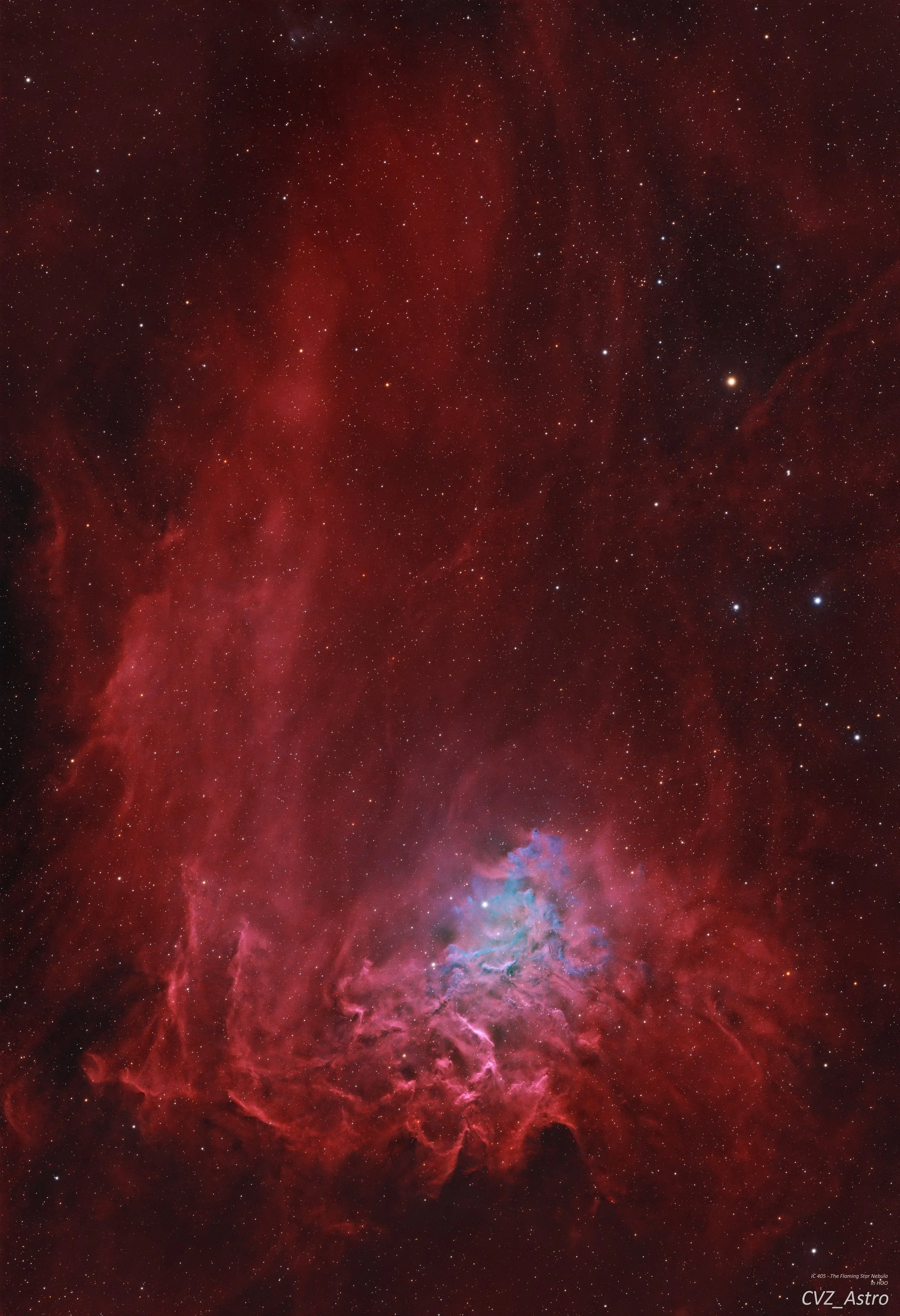
The Flaming Star Nebula, also designated Caldwell 31 and IC 405, is a beautiful nebula in the constellation Auriga. It is an emission and reflection nebula located approximately 1,500 light-years away from our planet, with an apparent size of 37 by 10 arcminutes, making it one of the larger nebulae in this part of the sky. Because of its elongated shape, actually framing the entire nebula within a single field of view was more of a challenge than I initially expected. It took some trial and error with my framing to make sure the full extent of the nebula, from tip to tip, fit comfortably into the shot without cropping off any of the fainter outer wisps. Luckily, earlier that month I had bought my newest camera, the ZWO ASI2600MC Air, which had a much bigger camera sensor compared to my ZWO ASI294MC Pro!
At the heart of the nebula sits the bright, irregular variable star AE Aurigae, which shines at magnitude +6.0. What makes this star particularly interesting is that it is not actually native to this region of the sky. AE Aurigae is a runaway star, moving through space at a high velocity of around 113 kilometers per second, and this motion has been traced back to the Orion Nebula, roughly 60 degrees away from its current position. About 2.6 million years ago, a near collision between two binary star systems is thought to have ejected AE Aurigae from the Trapezium Cluster in Orion at tremendous speed, and over time it has drifted into the cloud of gas and dust that now makes up IC 405, simply passing through it rather than having formed within it. The intense ultraviolet radiation from this hot, young star ionizes the surrounding hydrogen, producing the nebula's reddish emission glow, while its blue light is also reflected off nearby dust grains, creating the smoky, bluish structures that gave the nebula its name. The name Flaming Star was coined by the German astronomer Max Wolf, who described AE Aurigae as looking like a burning body with huge curved flames breaking out around it, when he first photographed the region in 1892.
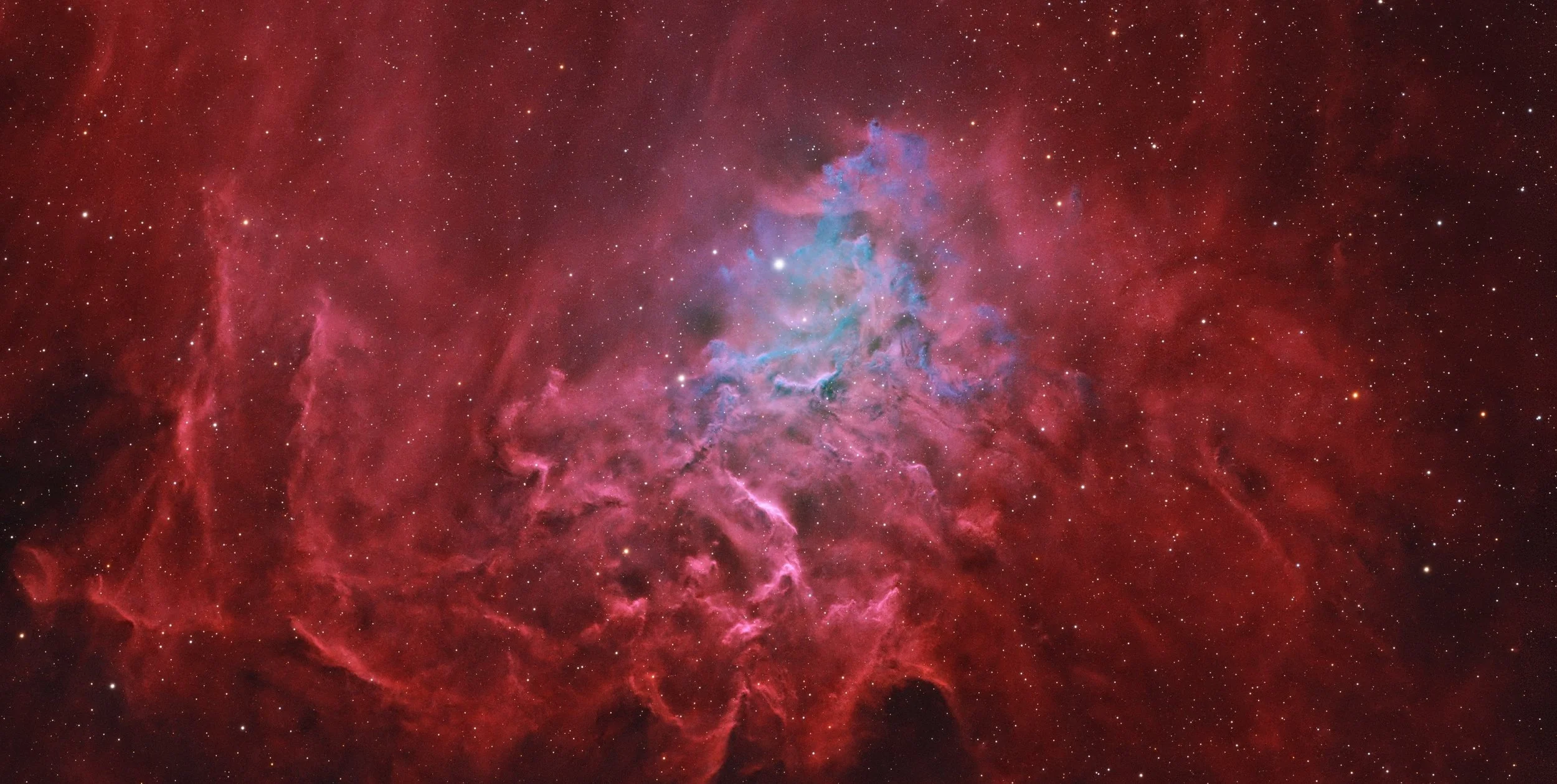
A close-up of variable star AE Aurigae,
Just next door to the Flaming Star Nebula lies its well known neighbor, IC 410, better known as the Tadpole Nebula, which forms part of the same larger star-forming complex in Auriga. Even though these two nebulae are often photographed together in a single wide field, I decided to treat them as two separate projects and capture each one individually, giving both objects the framing and attention they deserve on their own.
I processed this image of IC 405 twice, using two very different colour palettes. With my first attempt I used the Foraxx palette, which made the image look like fire, which was very fitting for a nebula like this, but I in the end I still was not happy with it. I revisited the same data and reprocessed it in the more classic HOO palette instead. Comparing the two side by side, HOO turned out to be my clear favorite for this nebula. It brought out the contrast between the reddish hydrogen emission and the blueish oxygen structures in a way that felt much more natural and true to the character of the nebula itself.
Someday I would still like to return to this region of Auriga and create a mosaic combining both IC 405 and IC 410 into a single, larger composition, but for now I am very happy with this result!
Acquisition details:
Optolong L-eNhance lights:
4hr 03min
54x 300sec
Calibration frames:
20 Darks
20 Flats
20 Dark flats
Bortle: 5
Gear used:
🔭 Askar 103APO
⚙️ Sky-Watcher EQ6-R Pro
📸 ZWO ASI2600MC Pro
🌌 Optolong L-eNhance 2”
My edit of this data in the Foraxx colour palette
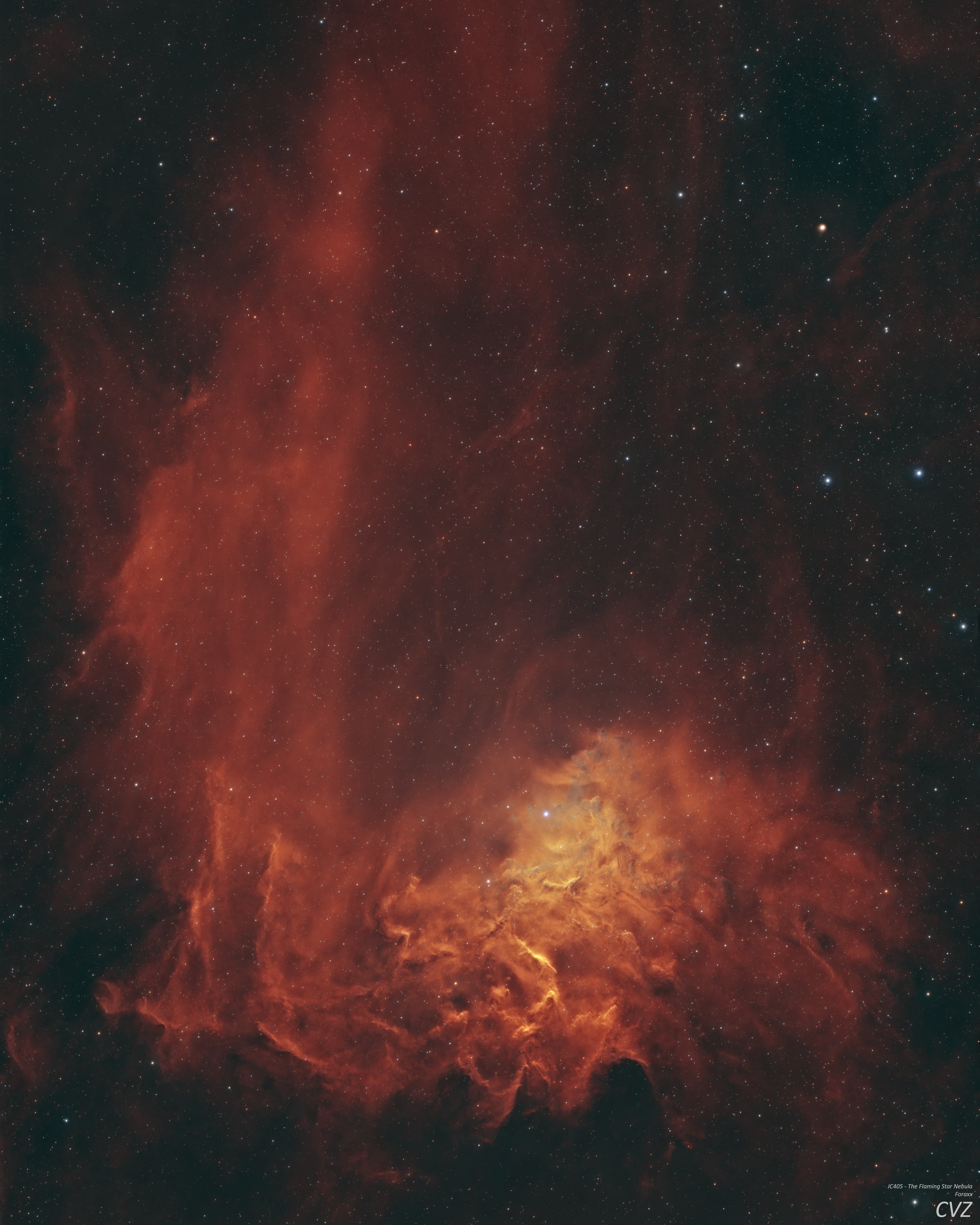
Caldwell 33 - The Flaming Star Nebula, photographed using my Askar 103APO telescope and ZWO ASI2600MC Air cooled deep-sky camera