
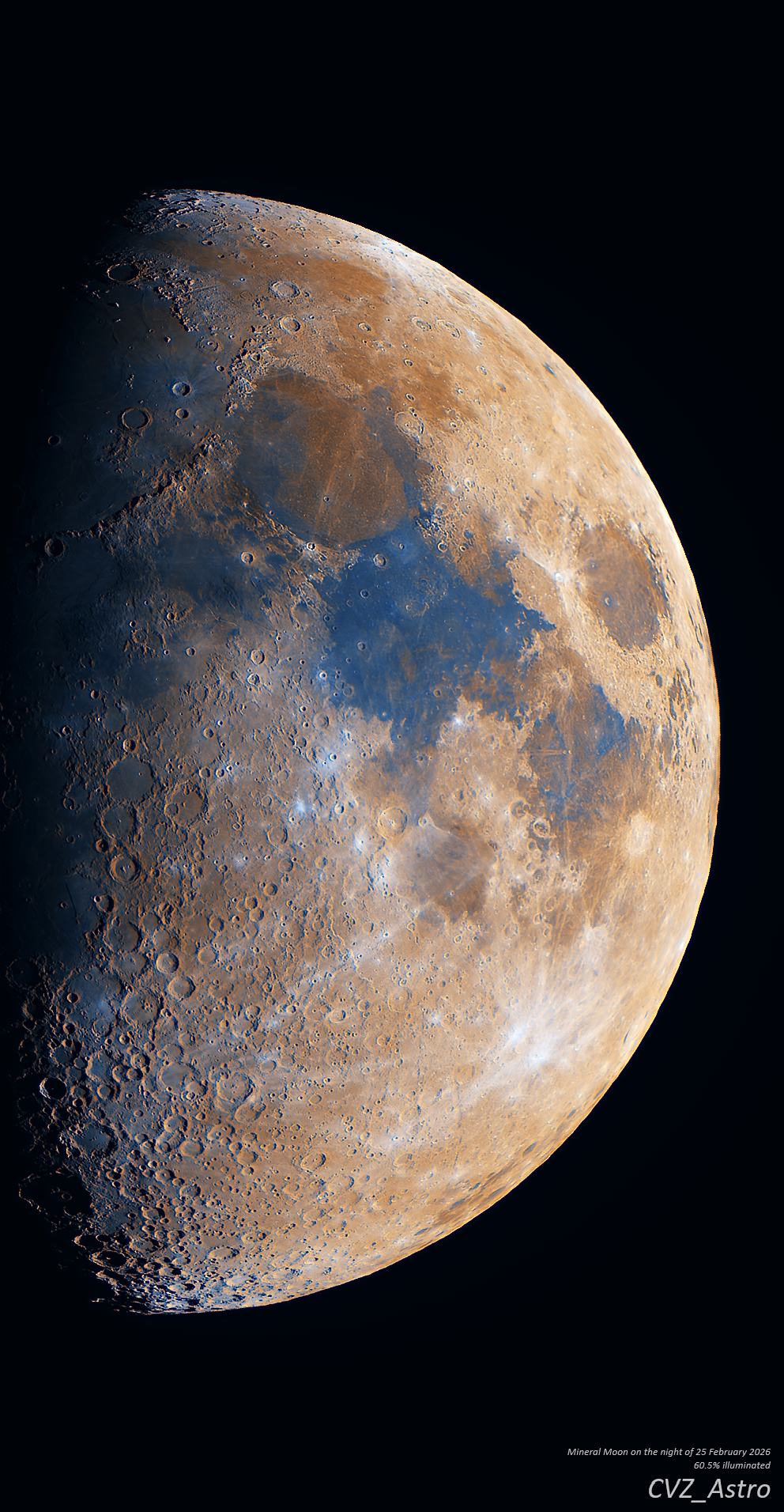
The Moon of 25-02-2026
Recently I realized that throughout 2025 I had not taken a single photograph of the Moon. Even during the lunar eclipse, I limited myself to observing through binoculars, but I don’t regret that at all! This past Wednesday however the sky cleared for several hours, and the Moon rose beautifully above my balcony like it always does. It was the perfect moment to return to lunar imaging once more.
Back in October 2024, when I last photographed the Moon, I experimented with making a mineral moon by saturating the colours of the image. The goal was to reveal the subtle blue and orange hues caused by variations in lunar surface composition. Unfortunately the result was far from ideal. Instead of distinct mineral regions, the image had a lot of unnatural purple and green gradients. Today I finally discovered the source of that issue. The colour gradients were introduced by the program I use to center individual frames before stacking: Planetary Imaging PreProcessor (PIPP). Because the Moon was already well centered in this recent dataset, I decided to skip that preprocessing step and proceed directly to stacking. The difference was immediately apparent.
When I increased the color saturation this time, the familiar green and purple gradients were nowhere to be seen. Instead delicate blue hues and slightly orange colours were revealed from the data, shwoing the Moon’s authentic mineral regions. It appears that PIPP, while extremely useful for planetary imaging where centering is essential, subtly altered the colour balance in my earlier workflow.
Going forward, I will likely reserve PIPP primarily for planetary data. In those cases, extreme colour saturation adjustments are rarely necessary anyway. Sometimes,the smallest changes in processing order can make the difference between artificial colour artifacts and a faithful representation of the subtle chemistry written across the lunar surface.
Acquisition details:
Gear used:
🔭 Askar 103APO
⚙️ Sky-Watcher EQ6-R
📸 ZWO ASI2600MC AIR
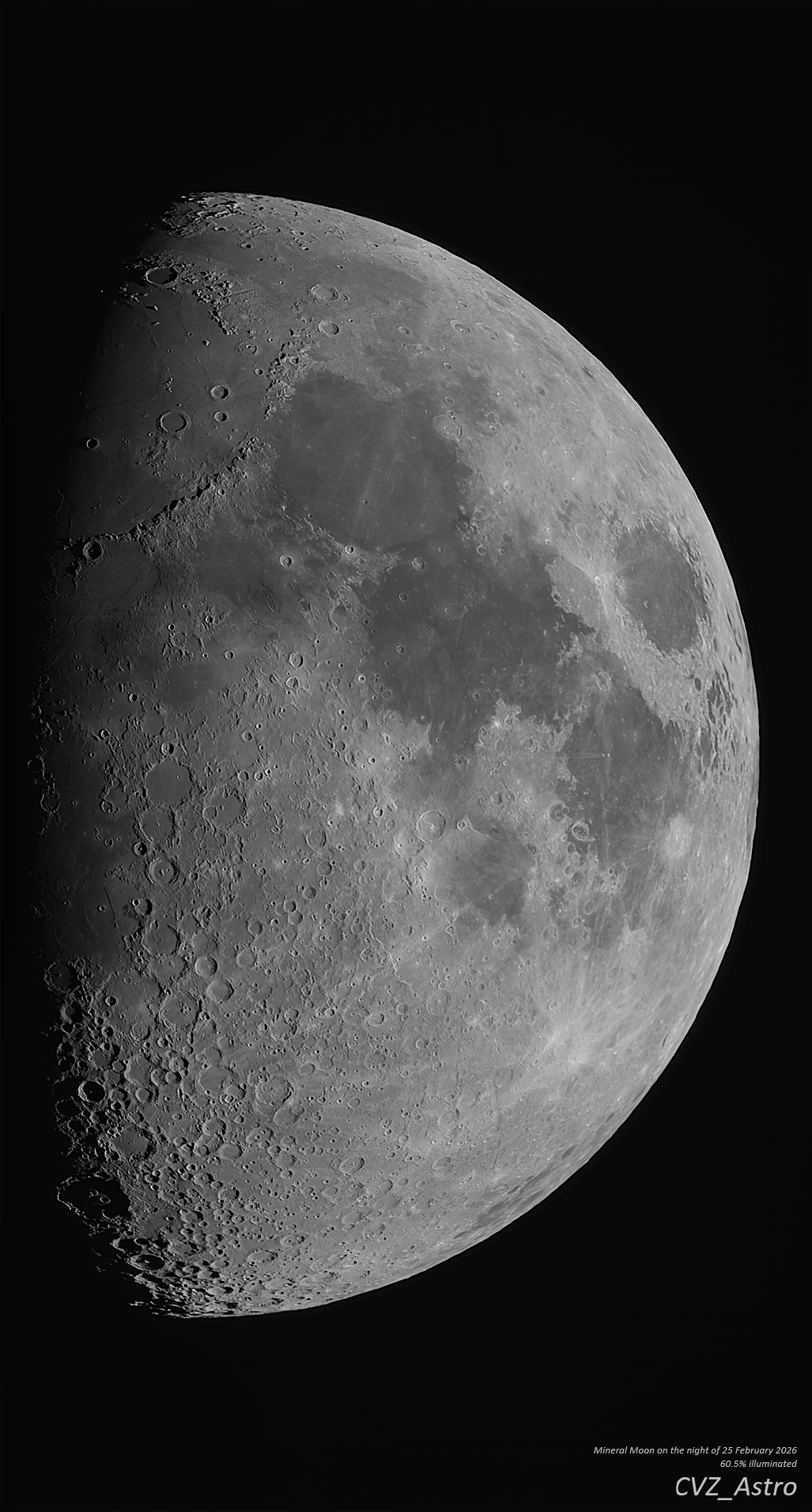

The Moon of 15-10-2024
On October 15, 2024, I captured this HDR Moon image using my Askar 103APO telescope and ZWO ASI294MC PRO cooled deep sky camera. It is the first time that I’ve taken an image of the moon with this telescope, and I’m pleasantly surprised by the amount of detail it has. Just like my last moon image, it’s definitely something I’d like to try again.
Acquisition details:
Gear used:
🔭 Askar 103APO
⚙️ Sky-Watcher EQ6-R
📸 ZWO ASI294MC Pro

HDR moon of 19-09-2024
On September 19, 2024, I captured this HDR Moon image using my William Optics Redcat 51 telescope. Creating an HDR (High Dynamic Range) Moon involves combining multiple exposures of the Moon taken at different brightness levels. One set captures the bright sunlit surface, while another captures the dimmer areas near the edge, such as the terminator or earthshine.
This technique allows you to reveal details in both the illuminated and shadowed regions within a single image, which is normally difficult due to the strong contrast across the lunar surface. It was a great challenge to create, and definitely something I’d like to try again.
Acquisition details:
Gear used:
🔭 William Optics Redcat 51 MK2.5
⚙️ Sky-Watcher EQ6-R
📸 ZWO ASI294MC Pro

Mineral moon attempt of 19-01-2024
On 19 January 2024, I set out to create a mineral Moon image using my William Optics Redcat 51 MK2.5 telescope. After a full evening of imaging, I ended up with a total of 500,000 frames. From this massive dataset, I selected the best 4,000 frames to stack. I've also tried to make a mineral moon edit it, and I think this one looks good. But to be honest, I have no idea what I did to get these colours. With all my other attempts I end up with weird green and purple gradients.
Despite being captured with a relatively small telescope, this mineral Moon shot reveals subtle color differences across the lunar surface, highlighting its varied composition.
Acquisition details:
Gear used:
🔭 Askar 103APO
⚙️ Skywatcher EQ5 Pro
📸 ZWO ASI294MC Pro