Caldwell 33 - The Eastern Veil Nebula
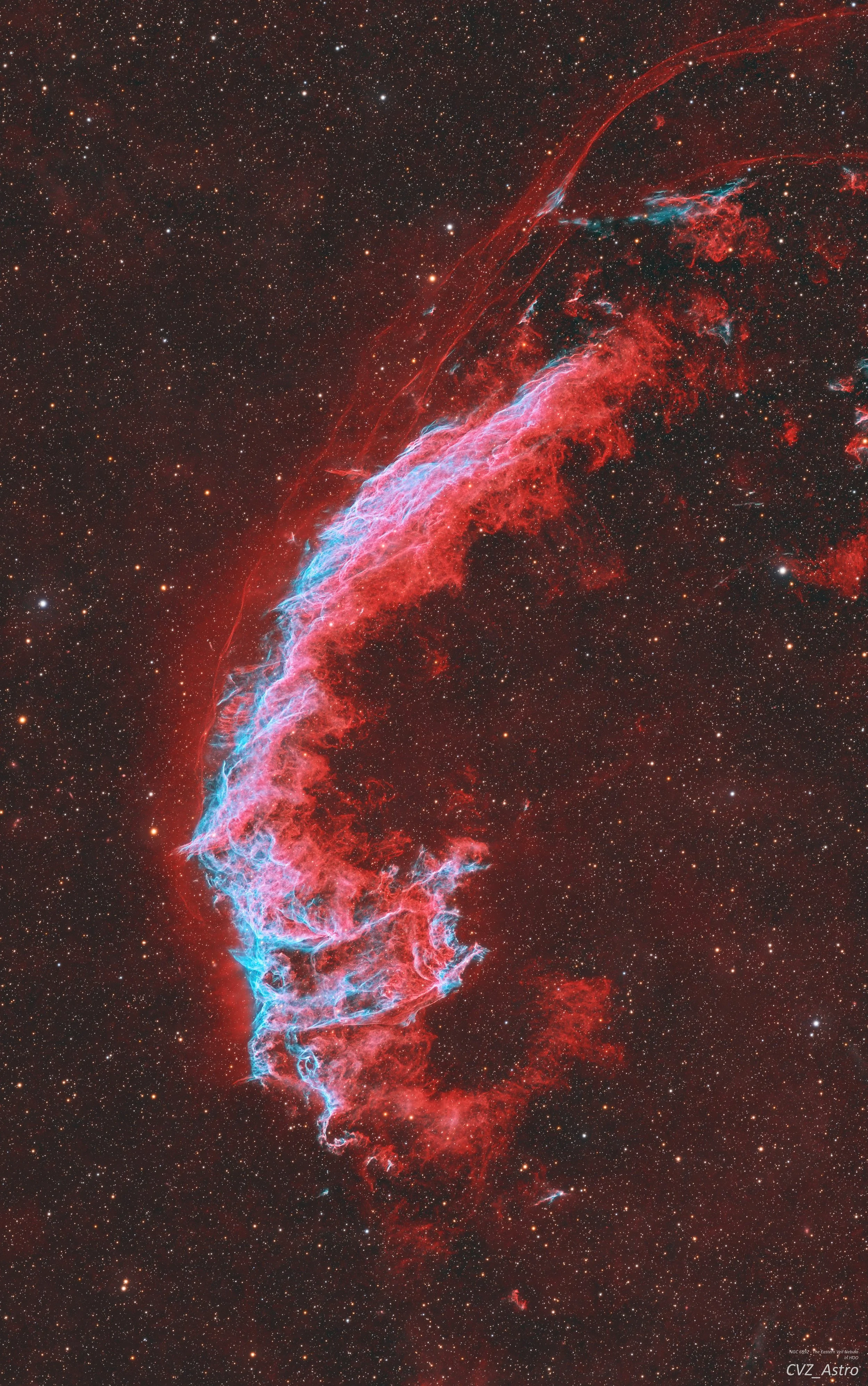
Caldwell 33, also known as the Eastern Veil Nebula, is one of the most alien looking supernova remnants in the night sky, and it has become one of my favorite nebulae to return to. It forms part of a much larger structure called the Veil Nebula or Cygnus Loop, which also includes Caldwell 34, the Western Veil Nebula, and Pickering's Triangle. Together these structures make up the visible remains of a massive star that exploded somewhere between 10,000 and 20,000 years ago! The full remnant now spans an area of the sky roughly six times the diameter of the full moon, even though it lies at a distance of about 2,400 light-years from Earth in the constellation Cygnus. When I look at an object like this, it is hard not to feel a bit of awe realizing that the light I am capturing tonight was set in motion by an explosion that predates recorded human history.
The Eastern Veil Nebula was discovered by William Herschel in 1784, who described it in his notes as a large, faint, extended nebulosity. It was not until much later that astronomers understood these filaments were not a single cloud of gas, but the shockwave of a supernova still expanding outward, sweeping up and heating the surrounding interstellar medium as it travels. That is exactly why the nebula has such a delicate, wispy structure. What we are really seeing is the collision between the blast wave of the supernova and the gas that already existed in that region of space, glowing as it is compressed and ionized.
Capturing this object became my summer project of 2025. I spent a total of nine nights on the Eastern Veil Nebula, slowly building up enough signal to bring out the fainter hydrogen alpha (Ha) filaments that tend to disappear into the background if not enough integration time is collected. For this image I used the HOO palette, using my Optolong L-eNhance dualband filter. The hydrogen alpha data reveals the warmer, reddish filaments of ionized hydrogen gas, while the Oxygen III (OIII) data reveals the cooler, teal colored regions where oxygen has been ionized by the shockwave. Mapping Ha to red, and OIII to green and blue produces the contrast that makes the intricate lace-like structure of the nebula really stand out.
This was not the first time I photographed the Eastern Veil Nebula. Back in 2023, I captured this object using my William Optics Redcat 51 MK2.5 telescope. At the time I remember how difficult it was to keep the bright oxygen-III signal under control during processing. This data blows out to white very quickly and loses a lot of detail if it is not stretched carefully. For this year's version, I kept a close eye on those regions while processing, and as a result the OIII filaments have stayed a much nicer cyan blue colour, preserving far more of the fine detail within them.
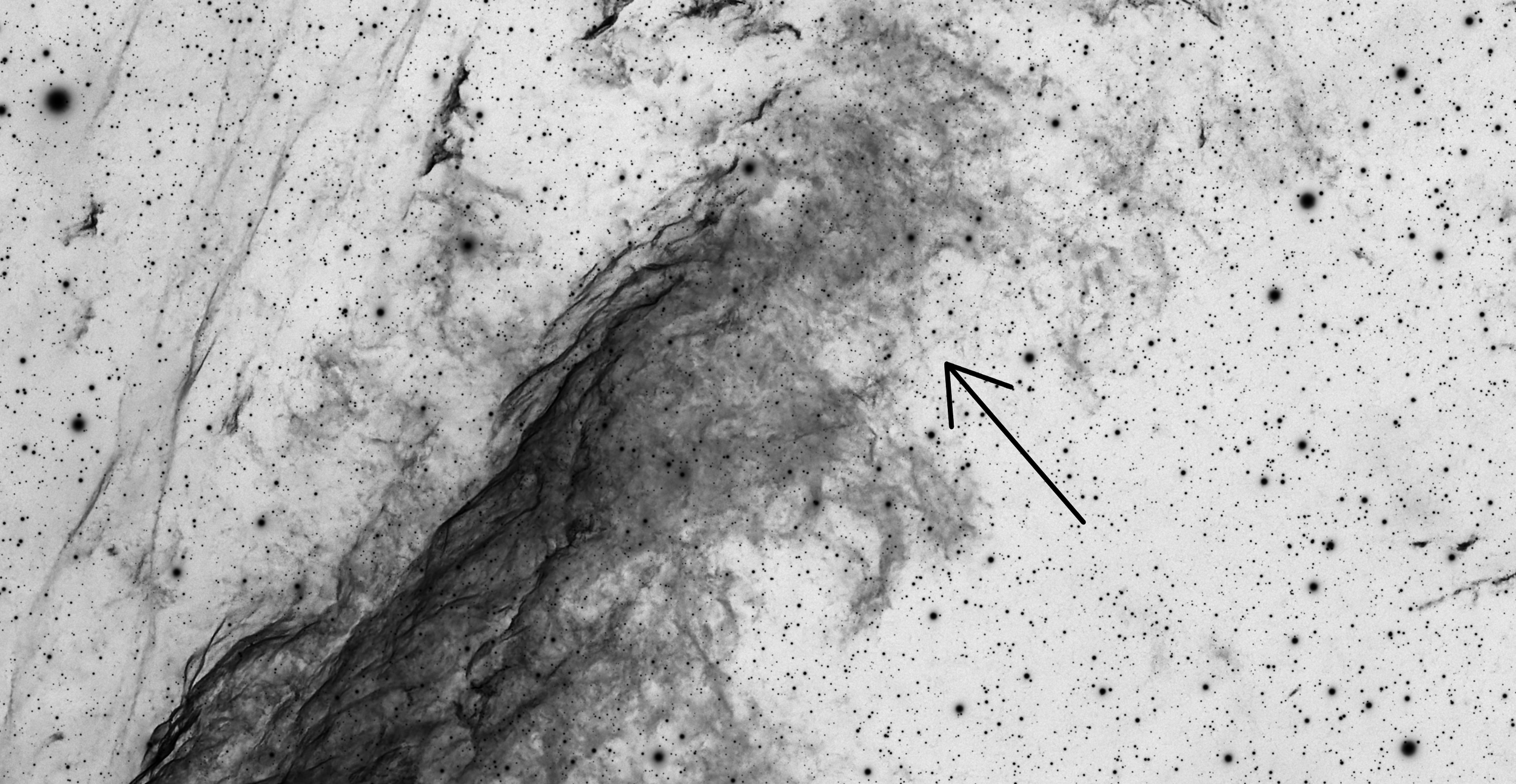
A close-up of the straight line filament
What amazes me most about this object is the level of fine detail hidden within the filaments once enough data is gathered. Thin threads of gas twist and cross each other throughout the frame, and the longer I spent processing this image, the more of these delicate structures started to reveal themselves. There is even a very straight line filament to be found in the image. Until recently I did not even know it was there! After nine nights of data, I feel like I have only scratched the surface of what this small section of the larger Cygnus Loop complex has to offer, and I would not be surprised if I return to this object again in the future with even more integration time.
Acquisition details:
Optolong L-eNhance lights:
35hr 05min
421x 300sec
Calibration frames (for each night):
20 Darks
20 Flats
20 Dark flats
Bortle: 5
Gear used:
🔭 Askar 103APO
⚙️ Sky-Watcher EQ6-R Pro
📸 ZWO ASI294MC Pro
🌌 Optolong L-eNhance 2”