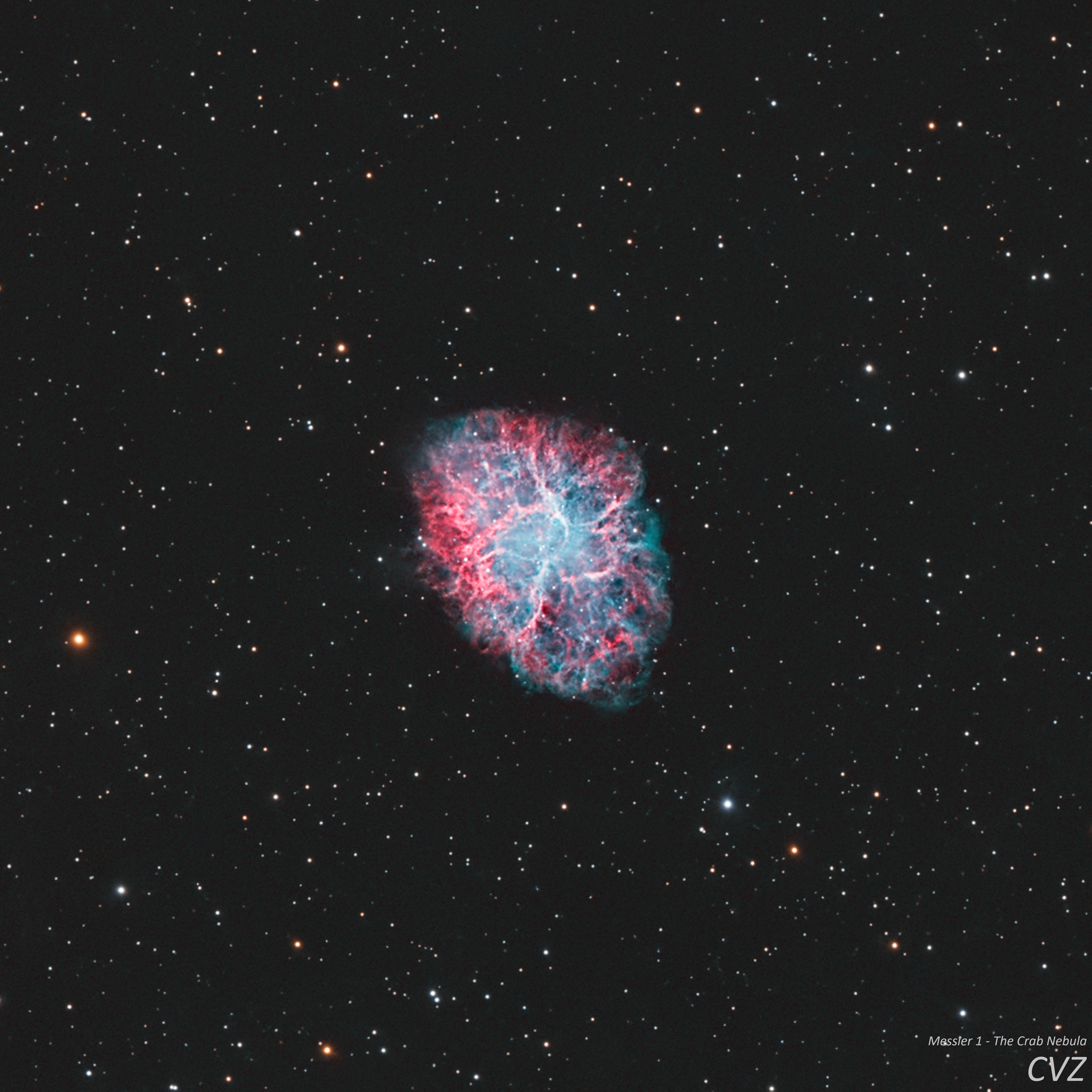
Messier 1 - The Crab Nebula
This image marked the first light for my ZWO ASI2600MC Air camera, and I could not have picked a more fitting target to start it off with. Messier 1, also known as the Crab Nebula, is the expanding remnant of a supernova explosion that took place in the year 1054. Historical records from several cultures, including Chinese, Japanese, and Arab astronomers, describe a "guest star" that suddenly appeared in the sky and remained bright enough to be seen in broad daylight for several weeks! Before slowly fading from naked eye visibility over the following two years. It is a strange thought that so many different civilisations, on opposite sides of the world, were independently documenting the very same event nearly a thousand years ago.
The nebula itself lies at a distance of roughly 6,500 light-years in the constellation Taurus, and spans about eleven light-years across. Interestingly Messier 1 also holds a special place in the history of astronomy for an entirely different reason. While searching the sky for a comet in 1758, Charles Messier came across this faint, fuzzy patch of light and initially mistook it for the very comet he was looking for. Realising his error, he decided to keep a catalog of these comet-like objects so that future astronomers would not make the same mistake, and the Crab Nebula became the very first entry in what is now known as the Messier Catalog.
Today the nebula continues to expand at an impressive rate of around 1,500 kilometres per second, and it is powered from within by a fast spinning neutron star known as the Crab Pulsar. This dense stellar remnant, only about 28 to 30 kilometres across, rotates on its axis roughly 30 times per second, sweeping powerful beams of radiation across the surrounding gas as it spins, NASA even made an animation where you can see the pulse. This continuous injection of energy is what excites the surrounding material and gives the nebula its diverse, colourful structure, ranging from the orange filaments of expelled stellar material to the blue/grey glow closer to the pulsar itself. What truly blows my mind is that some astrophotographers, such as fellow imager Adam Block, have been photographing this object for so many years in a row that they have been able to compile their data into short animations actually showing the expension of the nebula expansion in real time.
For this image I used the HOO colour palette, but the Crab Nebula is one of those cool targets that genuinely looks fantastic in almost any palette I tried. Choosing which version to settle on was surprisingly difficult, so below you can see a comparison of four different colour palettes applied to this same dataset!
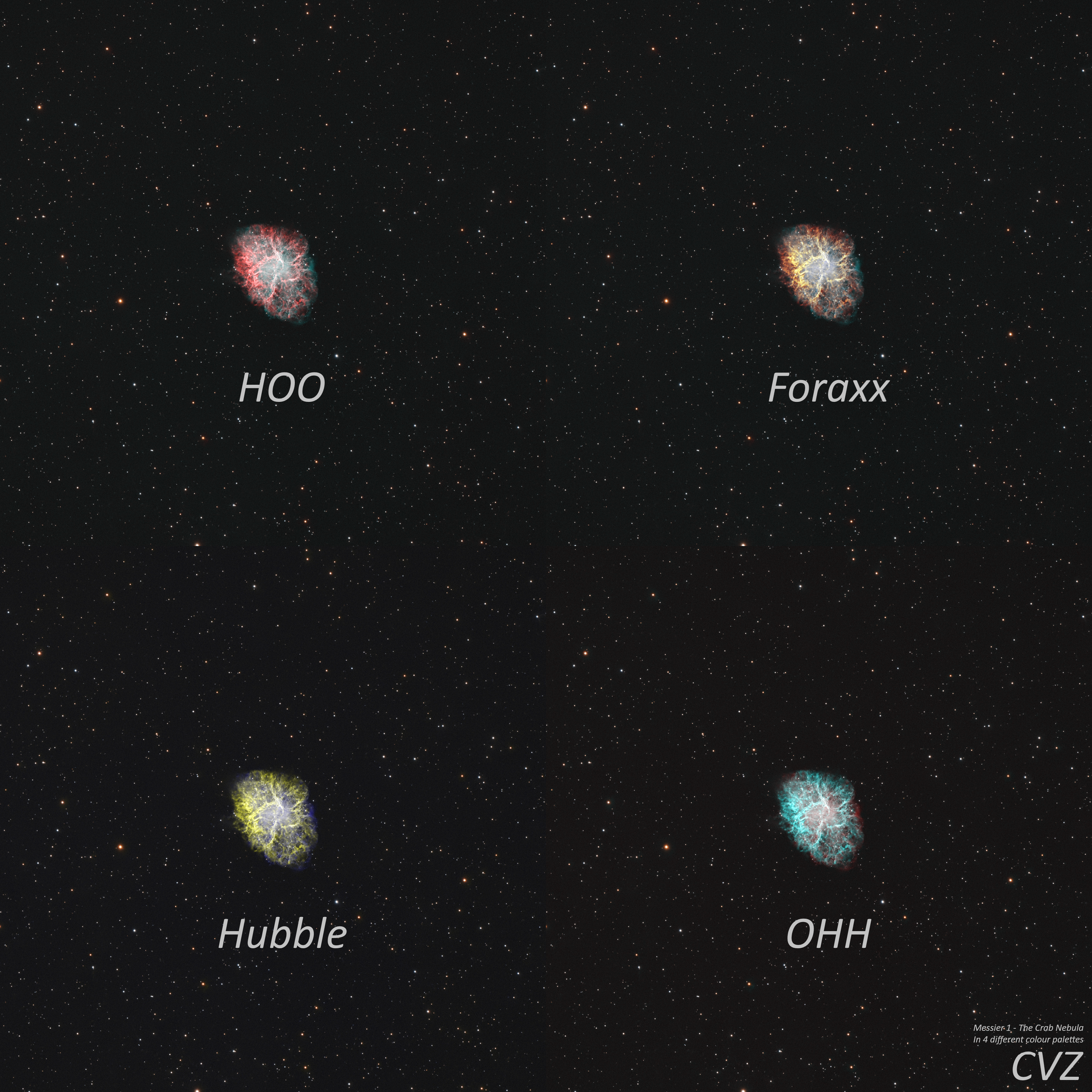
The Crab Nebula in different colour palettes
2026 edit: Now that I have also added the Optolong L-eXtreme and L-Synergy filters to my collection, I would really like to revisit this object at some point and put together a full SHO version as well, to see what additional structure and colour those filters might be able to reveal.
Acquisition details:
Optolong L-eNhance lights:
3hr 00min
36x 300sec
Calibration frames:
20 Darks
20 Flats
20 Biases
Bortle: 5
Gear used:
🔭 Askar 103APO
⚙️ Skywatcher EQ6-R Pro
📸 ZWO ASI2600MC AIR
🌌 Optolong L-eNhance