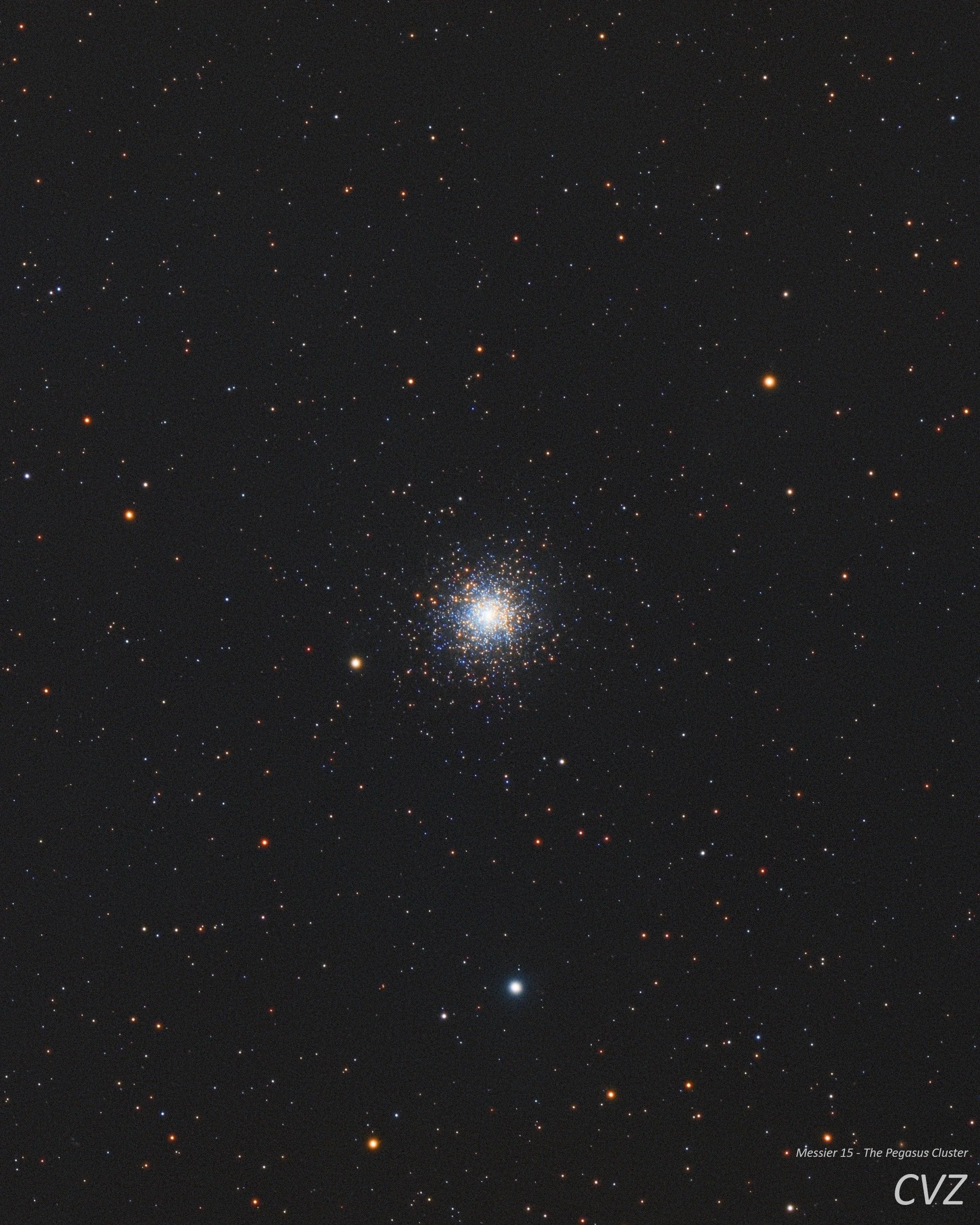
Messier 15 - The Pegasus Cluster
Messier 15 is one of my favorite globular clusters in the Messier Catalog. Just look at all those colourful stars, it looks amazing. Beside my personal opinion about that it is a beautiful globular cluster, I can of course share some facts about it too.
It is located in the constellation Pegasus and lies at distance of about 34.000 light-years away from our Earth. NASA conducted research on this globular cluster using data obtained from the Hubble Space Telescope. They discovered that the cluster has undergone a core collapse. Core collapse happens when massive stars in the cluster interact with less massive stars. When this happens, some individual stars migrate to the outer parts of the cluster. The remaining stars near the core become more densely packed, resulting in something that is called a power-law cusp. This means the closer you get to the core, the brighter it becomes. So the outer region expands and the core gets denser and brighter.
I read in a book by Gary Imm that this cluster contains a planetary nebula known as Pease 1. Unfortunately it does not appear in my image, because it it very hard to capture in broadband. And while researching this object further, I came across an image by Antoine and Daila Grelin, which shows the Integrated Flux Nebula too! Let us just say this is an object I would love to revisit in the future and turn into a larger project.
I captured this during a Messier Marathon I did in August 2025.
Hertzsprung-Russel diagram of Messier 15
In my recent Messier 13 blog post I wrote that I came across a new video on youtube by astronomer Adam Block. Where he explained that he found a Pixinsight script that enables astrophotographers like myself to generate Hertzsprung-Russel diagrams based on Gaia data that has been integrated into images like mine through platesolving and spectrophotometric colour calibration. So I have tried it, and I was quite surprised by the results. The diagram clearly shows the main sequence stars and some giants that can be found in the Great Hercules Cluster. In the Pegasus cluster we see a lot of giant stars and not a lot of low mass stars, it is funny to see how big of a difference there an be between the Messier globuar clusters. I think I’m going to generate these much more often, as they add some extra scientific depth to the images I post on my website.
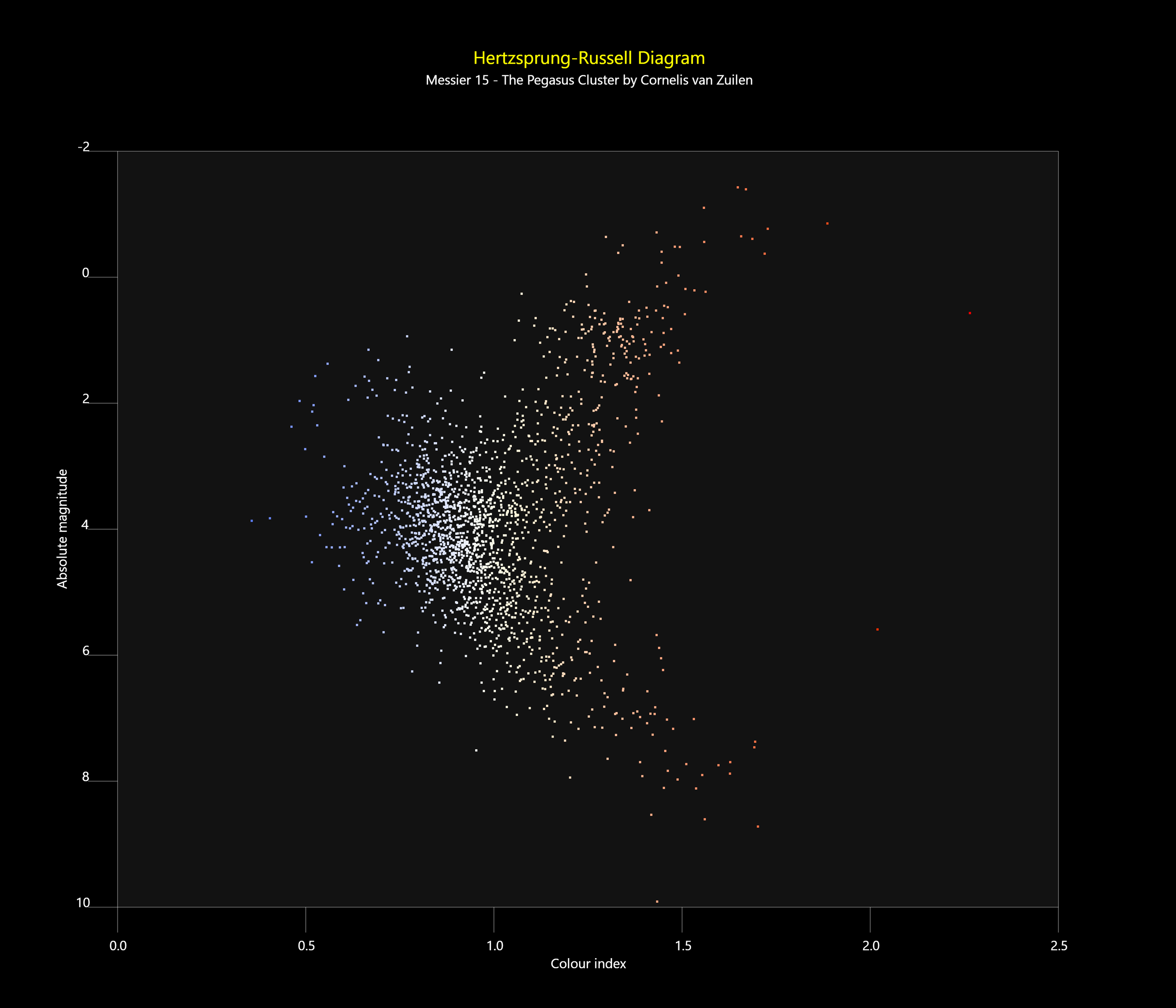
The Hertzsprung-Russel diagram of Messier 15, showing a lot of very bright stars
Acquisition details:
Optolong L-Pro lights:
0hr 10min
20x 30sec
Calibration frames:
20 Darks
20 Flats
20 Biases
Bortle: 5
Gear used:
🔭 Askar 103APO
⚙️ Sky-Watcher EQ6-R Pro
📸 ZWO ASI2600MC AIR
🌌 Optolong L-Pro