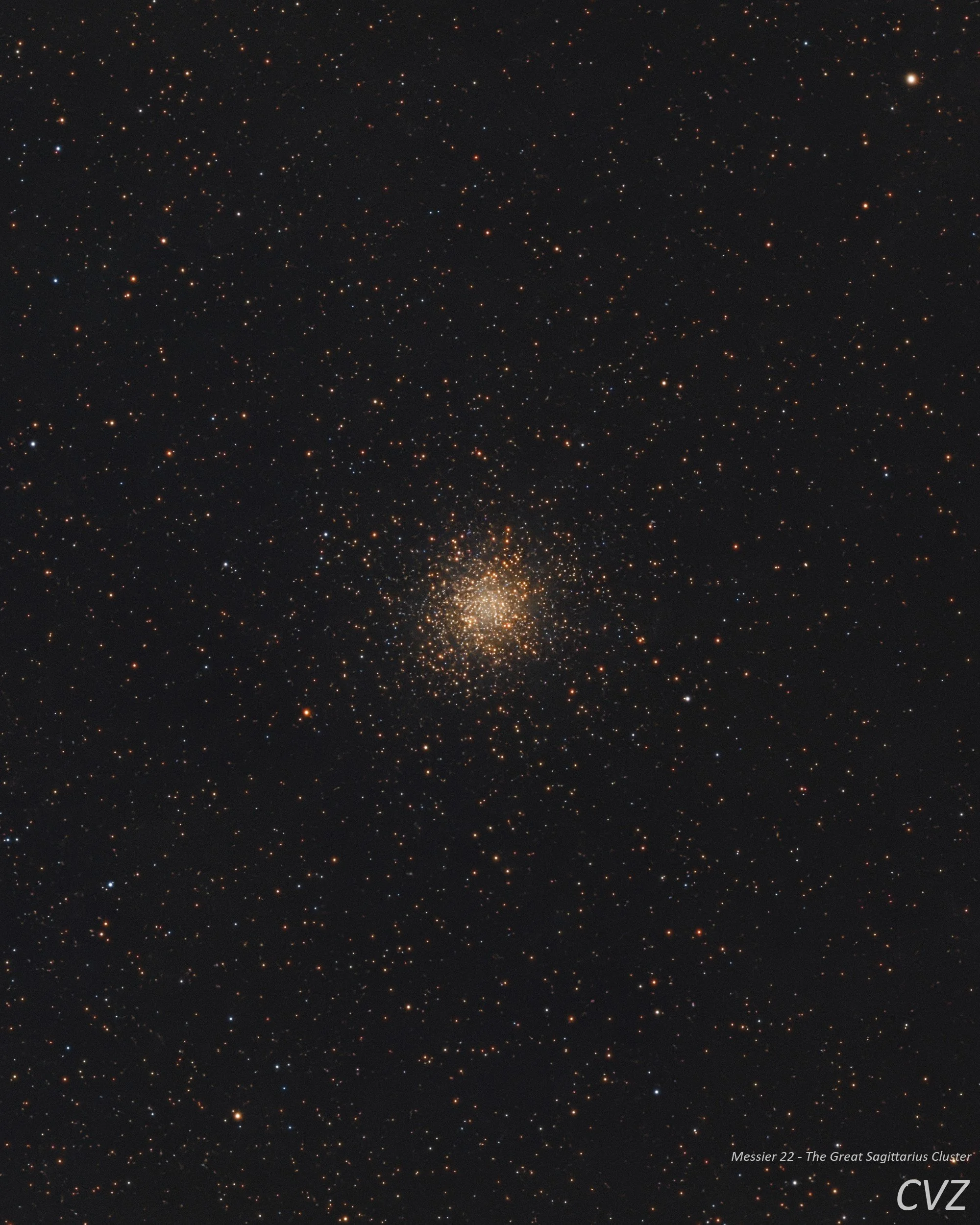
Messier 22 - The Great Sagittarius Cluster
Messier 22 is the second closest globular cluster to Earth, with M4 being the closest. This globular cluster is located in the constellation Sagittarius. It is known for containing many old giant stars, which are visible in the Hertzsprung-Russell diagram I made of it, more about that below.
This globular cluster is quite bright, with an apparent magnitude of 5.1–5.2. I have read about people being able to see it with the naked eye under very good sky conditions. Because it is in the constellation Sagittarius, it lies close to the Milky Way’s core from our point of view. As a result, the cluster appears against a dense background of stars. Sagittarius is known for having one of the densest star fields in the night sky.
I captured this image during a Messier Marathon in August 2025.
Hertzsprung-Russel diagram of Messier 22
Using the Cosmic Photons Hertzsprung-Russell diagram script I recently came across while watching some YouTube videos by Adam Block, I have been making a few of these diagrams. The cool thing about this one is that it is not only the first one I have made with a lot of giant stars, but it also shows a white dwarf which is visible in the lower left part of the diagram.
After a star loses its outer layers during the final stages of its life, only the compact, bright core remains. This remnant is called a white dwarf. The core is no longer fusing hydrogen, and it shines due to residual heat until it gradually cools and eventually stops glowing, becoming a black dwarf. This process takes tens of billions of years. Since the universe is only about 13.8 billion years old, it is safe to say that there are not any black dwarfs in existence yet.
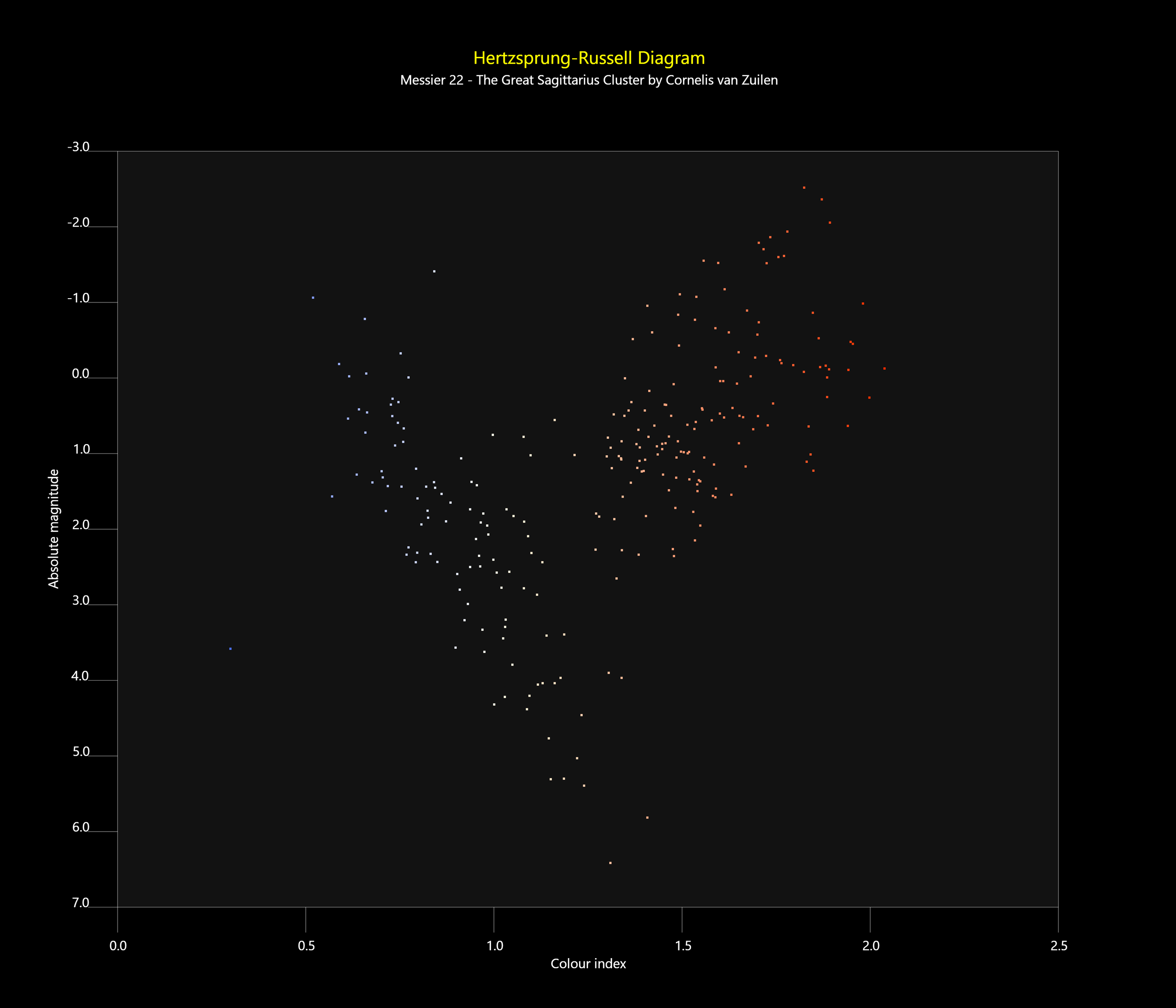
The Hertzsprung-Russel diagram of Messier 22, with the white dwarf on the left side of the diagram.
Acquisition details:
Optolong L-Pro lights:
0hr 10min
10x 30sec
Calibration frames:
20 Darks
20 Flats
20 Biases
Bortle: 5
Gear used:
🔭 Askar 103APO
⚙️ Sky-Watcher EQ6-R Pro
📸 ZWO ASI2600MC AIR
🌌 Optolong L-Pro