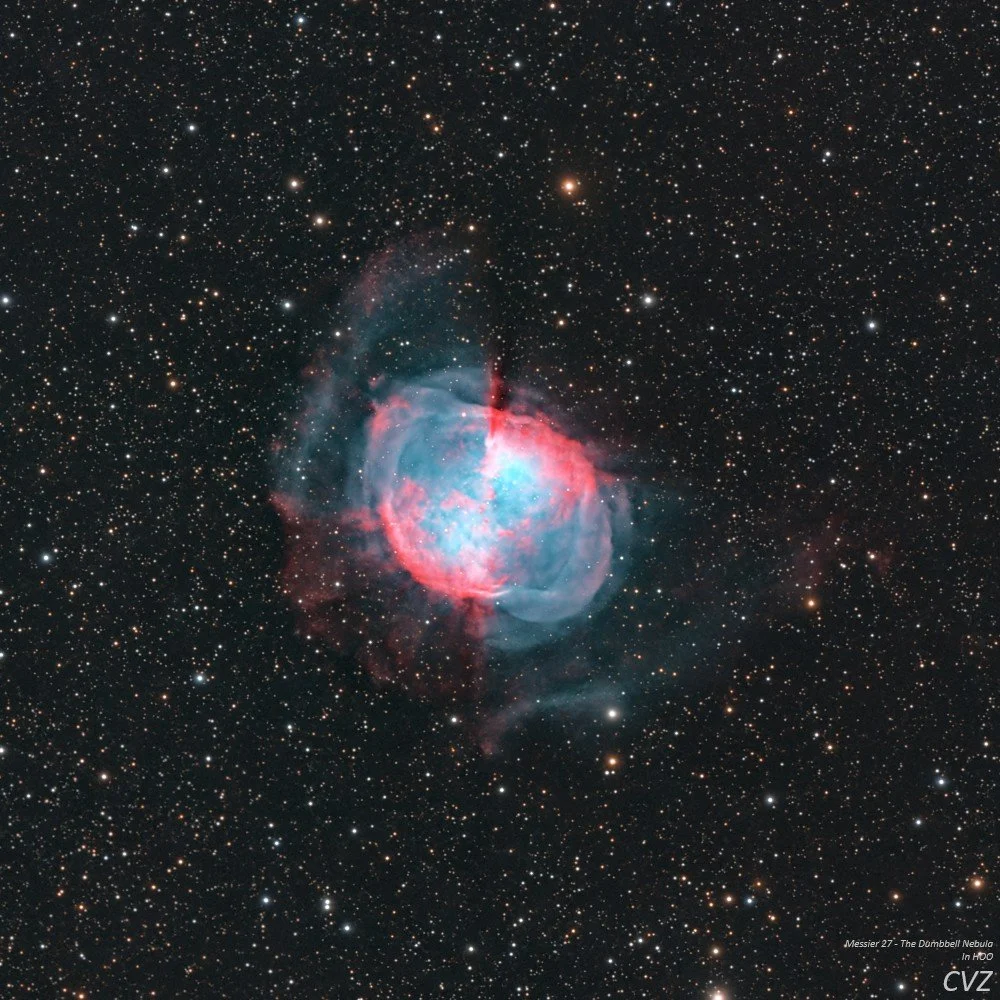
Messier 27 - The Dumbbell Nebula
Messier 27 is the largest planetary nebula in the Messier Catalog by apparent size and was discovered by Charles Messier himself in 1764. It is located in the constellation Vulpecula at a distance of roughly 1,200–1,400 light-years from our Earth. The nebula gets its name, the Dumbbell Nebula, from the shape it resembles. However with long enough exposures, faint wing like structures on both sides of the nebula become visible. With these faint wings, it looks more like a butterfly to me.
Being a planetary nebula means that the star at its center has reached the final stages of its life. After fusing most of its hydrogen, the star shed its outer layers, leaving behind a hot white dwarf with an apparent magnitude of around 14. This central white dwarf is believed to be one of the hottest known, emitting intense ultraviolet radiation.
The UV radiation from the white dwarf ionizes the surrounding gas, causing it to glow in these vivid colors. For this image, I used the HOO color palette, which consists of hydrogen-alpha (Hα) mapped to red and oxygen III (Oiii) mapped to blue and green.
Images taken by the Hubble Space Telescope also make use of a nitrogen II (Nii) filter, which isolates singly ionized nitrogen. Some amateur astrophotographers additionally use an Sii filter to capture singly ionized sulfur and incorporate it into their images. Now that I have a dualband filter that isolates Sii and Oiii, I might give that a try as well.
In the end, Messier 27 is a spectacular and highly diverse nebula in our night sky, and I highly recommend observing it with your own telescope.
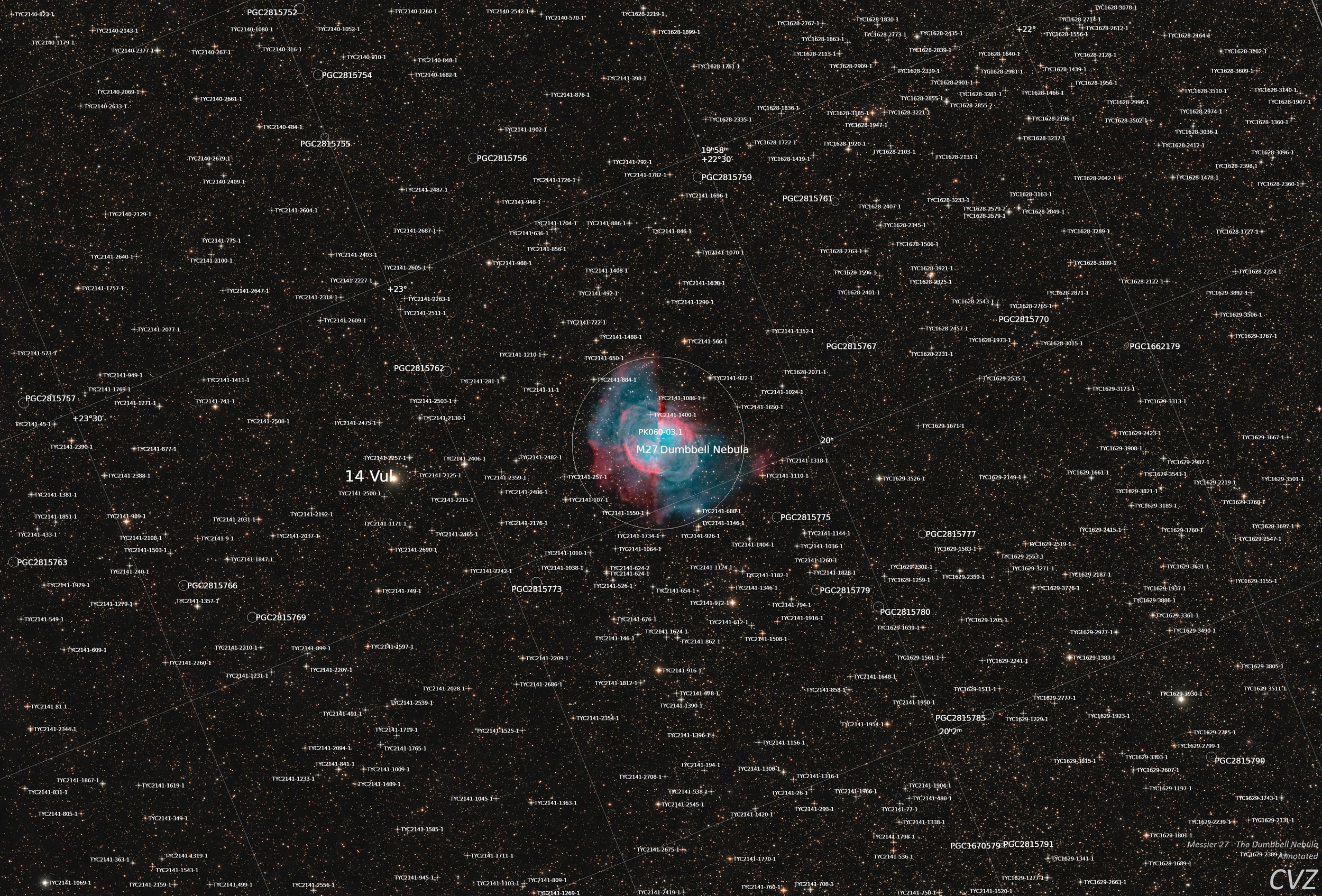
The fully annotated version of Messier 27 - The Dumbbell Nebula
Acquisition details:
Optolong L-Pro lights for RGB stars:
0hr 30min
15x 120sec
Optolong L-eNhance lights:
4hr 45min
56x 300sec
Calibration frames:
20 Darks
20 Flats
20 Biases
Bortle: 5
Gear used:
🔭 Askar 103APO
⚙️ Sky-Watcher EQ6-R Pro
📸 ZWO ASI294MC Pro
🌌 Optolong L-eNhance & L-Pro