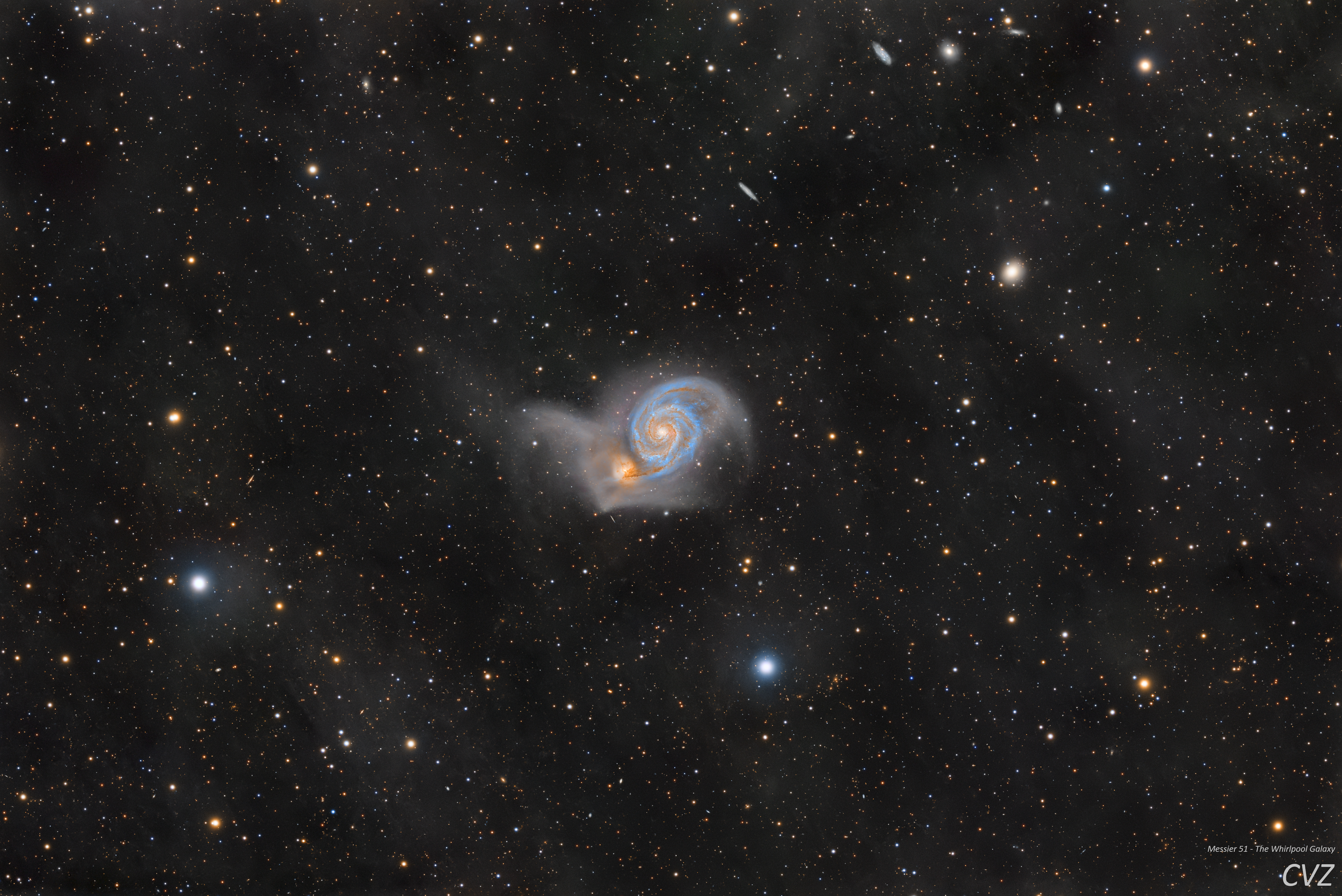
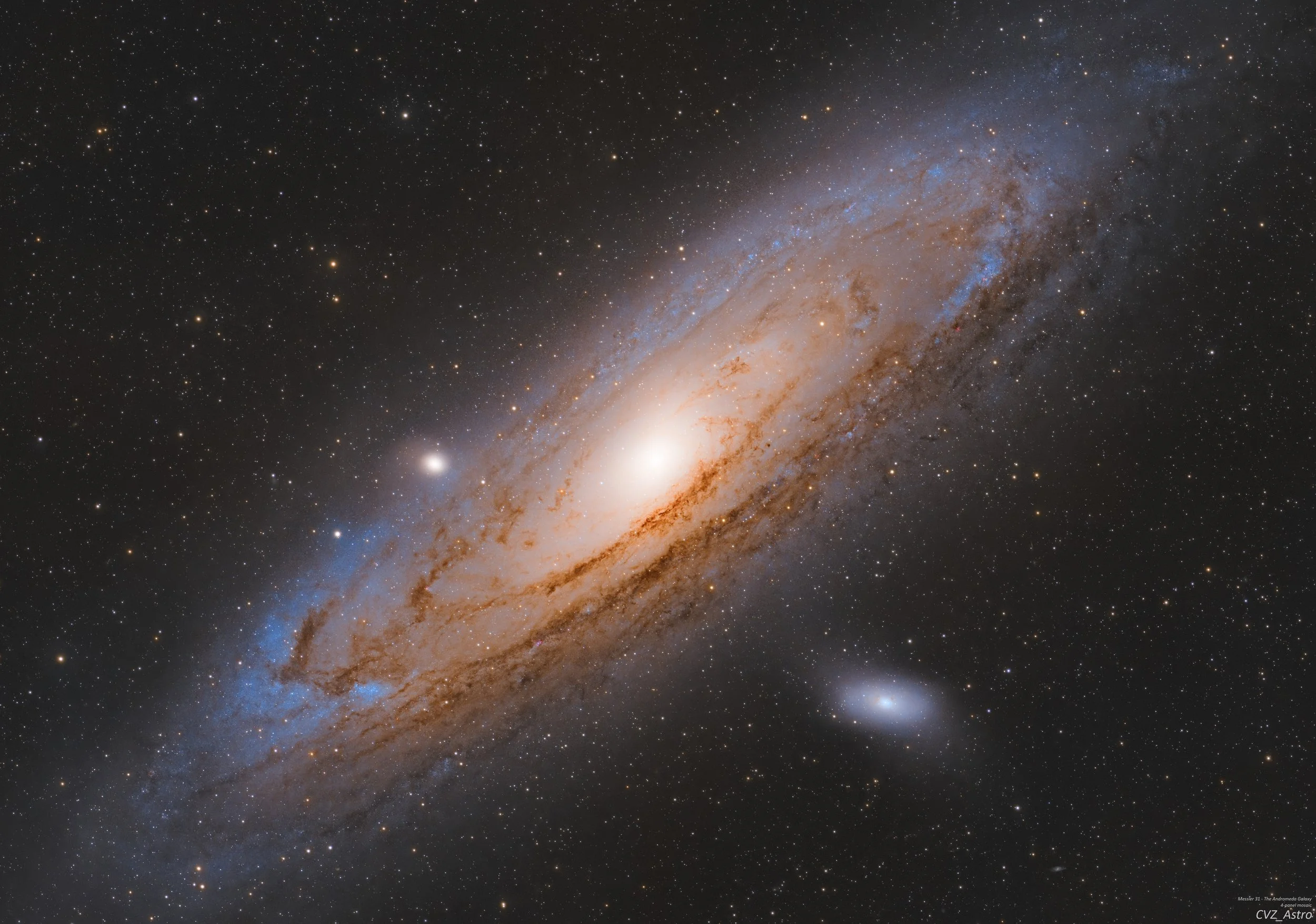
Messier 31 - The Andromeda Galaxy
A historical perspective on Messier 31, the Andromeda Galaxy
Messier 31, also known as the Andromeda Galaxy, is probably the most extensively studied galaxies near us. In many cases, it is possible to identify a specific individual as the discoverer of an celestial object, however due to its large apparent size and brightness in our night sky, the Andromeda galaxy has been known to humanity for a very long time.
The earliest known written obversation dates back to the year 964 AD, the Persian astronomer Abd al-Rahman al-Sufi described it in his Book of Fixed Stars. he reffered to the object as a “"small cloud of stars. Centuries later, Charles Messier also encountered this object during his search for comets. In 1763 he described it as ”A Nebula without stars, near the star ν Andromedea, it is very faint and difficult te see.”
The telescope Messier used back then had a focal length of approximately 1-1.2 m and an apature of about 9 centimeters, which is relatively modest compared to the telescopes used by later astronomers. Nevertheless, this telescope was well suited to Messier his objectives. Comets often have extented tails, and a wider field of view would have aided in distinguishing them from other diffuse objectes in the sky. From my own experience searching for comets, I have observed several long tails, such as C/2023 A3 (Tsuchinchan-ATLAS), also known as the Great Comet of 2024. If you would like to see the photograph I took of this comet, be sure to click here.
It was not until 1924 that Edwin Hubble demonstrated that the Andromeda “nebula” lies far beyond the boundires of the Milky Way and was, in fact a galaxy in its own right. Using the 100 inch Hooker Telescope at amount Wilson Observatory, Hubble obtained long exposure photographs of Andromeda and identified several Cepheid variable stars, which are known also known as standard candles. Cepheids exhibit periodic variations in brightness, with longer periods corresponding with it begin brighter. By measuring these stars, Hubble was able to calculate the distance to Andromeda, showing that it was far too distant and too large to be part of the Mily Way. This discovery ultimately resolved the long standing debate over whether spiral nebulae were part of our galaxy or independent “island universes” comparable to the Milky Way.
Object data about Messier 31
Now that we understand how humanity discovered that the Andromeda “nebula" is in fact a galaxy, we van turn our attention to what is currently know about Messier 31 in the 21st century. Like many other astronomical objects, the Andromeda Galaxy is also listed in the New General Catalogue, under the designation NGC 224. it is a spiral galaxy, simular to our Milky Way, as well as to other well known systems such as Messier 81 (Bode’s Galaxy) and Messier 101 (the Pinwheel Galaxy).
With an apparent magnitude of approximately 3.3, the Andromeda Galaxy is visible to the naked eye from a dark sky location. I live in a Bortle 5 area, near the boundary of Bortle 4, where the galaxy is easily observable through binoculars. It was also the first galaxy I eve located usiing my old Omegon telescope when I began with the amazing hobby. In the Netherlands, there are still a few sites where the night sky becomes truly dark. During the summer of 2023, I visited on of these locations and was able to observe the Andromeda Galaxy with the unaied eye.
As you might know, the Andromeda Galaxy is the closest large galactic neighbour to the Milky Way, located at a distance of approximately 2.5 million light-years. The means that the light we observe today has been traveling through space for 2.5 million years before reaching our telescopes. The idea that these ancient photons arrive precisely in time to be captured by our light buckets, blows my mind. Because of its relative proximity, Andromeda appears exceptionally large in our night sky. It has an angular diameter of roughly 3 degrees. That’s about six times the apparent diameter of the moon.
The real diameter of the Andromeda Galaxy spans approximately 200,000 light-years, making it significantly larger than the Milky Way, which is estimated to be about 100,000 - 130,000 light-years in diameter. Astronomers estimate that Andromeda contains between 800 billion and 1.5 trillion stars, marking it status as one of the most massive galaxies in the Local Group.
Messier 32 & 110, the companions of the Andromeda Galaxy
The Andromeda Galaxy is accompanied by two prominent satellite galaxies, two dwarf glaxies that lie close to Messier 31 itself. The first of these companions is Messier 32, also known as NGC 221. With and apparent magnitude of approximately 8.1, it is significantly fainter than its much larger host galaxy. Messier 32 was first diacovered in 1749 by astronomer Guillaume Le Gentil and was later included in Charles Messier’s catalog.
Due to its extremely compact and dense cature, Messier 32 is classified as a Compact Elliptical Galaxy (cE). Astronomers believe that strong gravitational interactions with Messier 31 have stripped this dwarf galaxy of much of its outer stellar material, leaving behind the dense core we see today. Despite its relatively small size, Messier 32 is known to have a supermassive black hole at its center.
Messier 110 on the other hand, is a less compact system. It is also an elliptical dwarf galaxy, but with a flattening of approximately 50%, giving it a shape that is more like a disk, than spherical. An interesting historical detail is that Messier 110 was not included in Charles Messier’s original catalog, which initially contained 103 objectes. Objects such as Messier 110 were added latr by other astronomers, bases on Messier’s observational notes.
The dwarf galaxy has several unusual characteristics for an elliptical galaxy. Near its core, astrnomers have indentified populations of young, blue stars along with dusty regions. These are features that are not commonly associated with this galaxy type. These faint bronisch dust lanes and blueish stars are also visible in my mosaic! Unlike Messier 32, Messier 110 does not appear to have a supermassive black hole at its center. Instead its nucleus is thought to be dominated by a dense, compact star cluster. which may play some role in the presence of the young stellar populations.
Messier 110 is also in the New General Catalogue, under the designation NGC 205 and was independently discovered by Caroline Herschel on 27 August 1783. With an apparent magnitude of approximately 8.5, it is slightly fainter than Messier 32, but remains an interesting and scientifically rich companion to the Andromeda Galaxy.
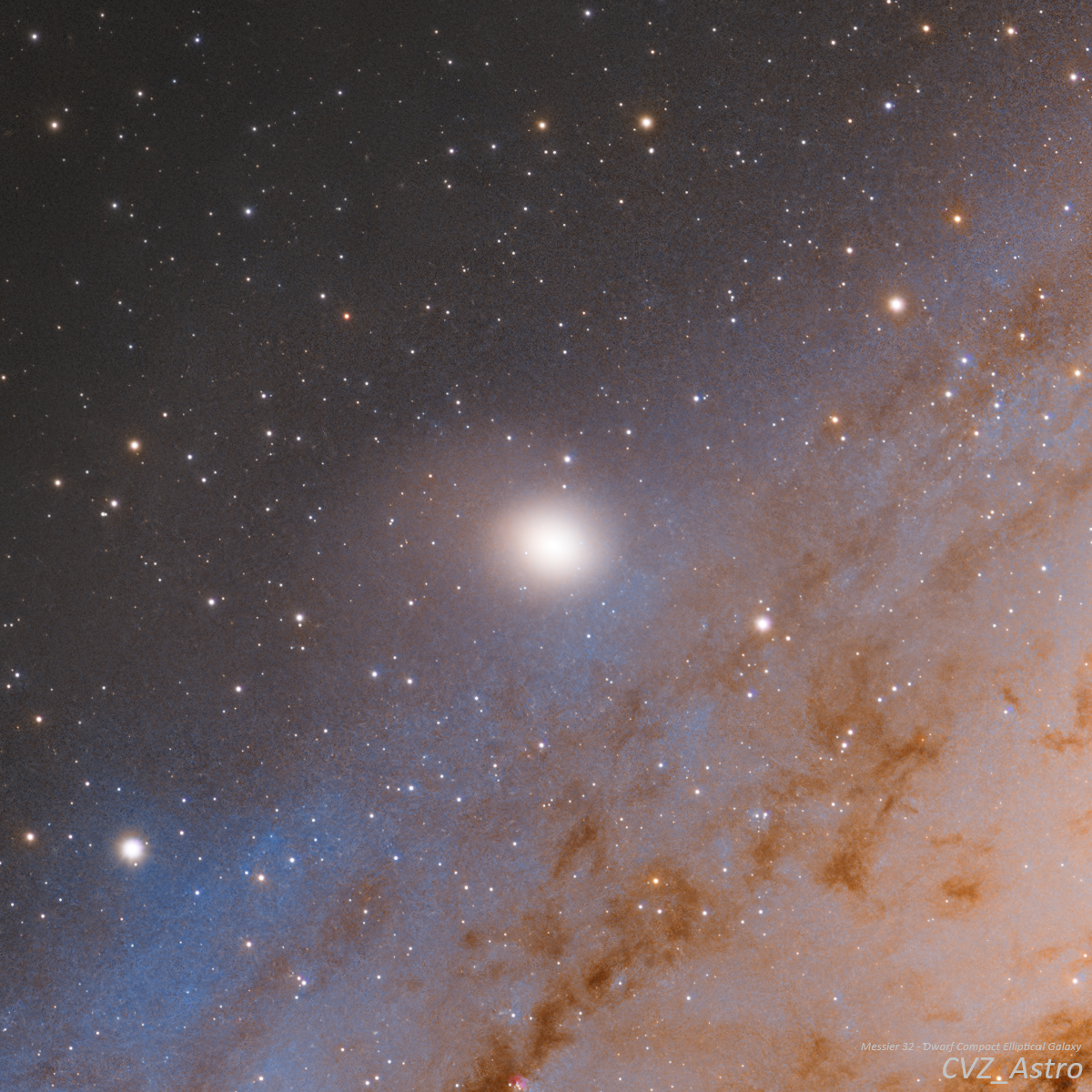
Messier 32 - The Dwarf Compact Elliptical Galaxy
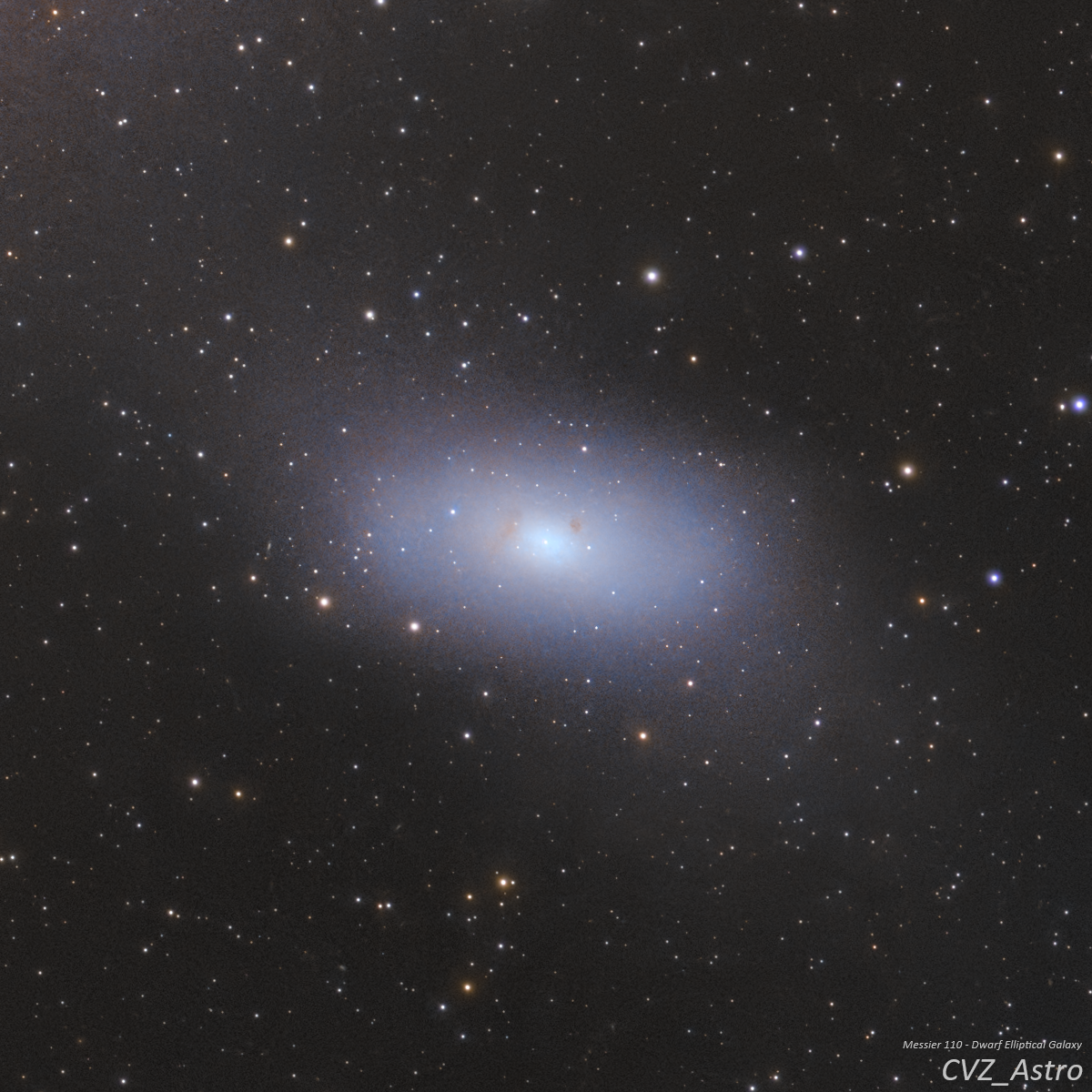
Messier 110 - The Dwarf Elliptical Galaxy
How I made the mosaic
Approximately two years ago, I last captured the Andromeda Galaxy using my William Optics Redcat 51 MK 2.5 telescope. As part of my ongoing effort to photograph the entire Messier Catalog, it was of course very important for me to obtain a high-quality image of one of its most famous objects. Paired with my growing interest in making mosaics, Andromeda presents itself as a good target due to its massive size in our night sky. Its vast dynamic range and dark dust structures make it a very challenging object to process, so it took me a few nights to get it right. In the end I’m very happy with how the final image turned out.
the proces of creating the mosaic itself was quite simple to be honest. For my setup, I use a ZWO ASIAIR. which allows me to create so-called “Plans”. One pf the available options wihin this feature is the ability to add multiple panels to the field of view (FOV), effectively making a mosaic layout. As I am still new to mosaic imaging, I researched how to make one and found that many other astrophotographers recommend an overlap of approximately 10% between panels. This ensures that, after cropping the stacking artifacts from the individual panels, there remains sufficient overlap to seamlessly stitch the mosaic together.
The data were processed by me in the follwing order:
Cropping -> Platesolve -> BlurX correction only -> GradientMergeMosaic -> MosaicByCoordinates -> DBE -> SPCC -> BlurX -> NoiseX -> StarX -> Stretching both the Stars and Starless images -> Curves (with masks) -> Recombination of the Stars and Starless images. This workflow is somewhat diffirent from my usual processing routine, particulary regarding the timing of DBE.
Normally I apply DynamicBackgroundExtraction earlier in the process. However, in this case applying DBE to the individual panels caused issues due to the extremely bright core of the Andromeda Galaxy appearing near the corners of all the panels. This resulted in overcorrection and unnatural backgrounds. By applying DBE after stitching the mosaic, the results were way better and far more natural looking.
During the edting process, I came across a recently released Hubble Space telescope mosaic of the Andromeda Galaxy, which featured an overview highlighting some of the interesting regions and objects within Messier 31. And I love this kind of images, I’ve also made something like this for the famous Trapezium and a protoplanetary-disk in the Orion Nebula, so I decided to so something simulair. Only, my mosaic does not come close to the resolution achieved by Hubble, and many of the extremely fine details visible in this professional mosaic are far less prominent in my mosaic. This motivated me to conduct additional research to identify other noteworthy objects that could still be detected in my image.
That is when I came across something truly special, a Luminous Red Nova (LRN). An LRN is a rare type of nova, diffirent from its normal counterparts. Where a normal nova features a white dwarf stealing hydrogen from its bigger companion. And a supernova, which involve the collapse of a massive star. A lumious red nova occurs when two stars spiral inward and merge, producing a powerful outburst of energy and an expanding shell of ejected material.
The LRN in my mosaic is designated as AT 2025abao, and was dicovered in October 2025, just a few months before I began this project. It is visible in the lower left region of the mosaic. For astronomers such events are of great interest, as the provide valuable insight into stellar merges and late stage stellar evolution. For an astrophotographer like myself, capturing such a rare phenomenon adds an extra layer of depth ito the image and makes this mosaic particularly special.
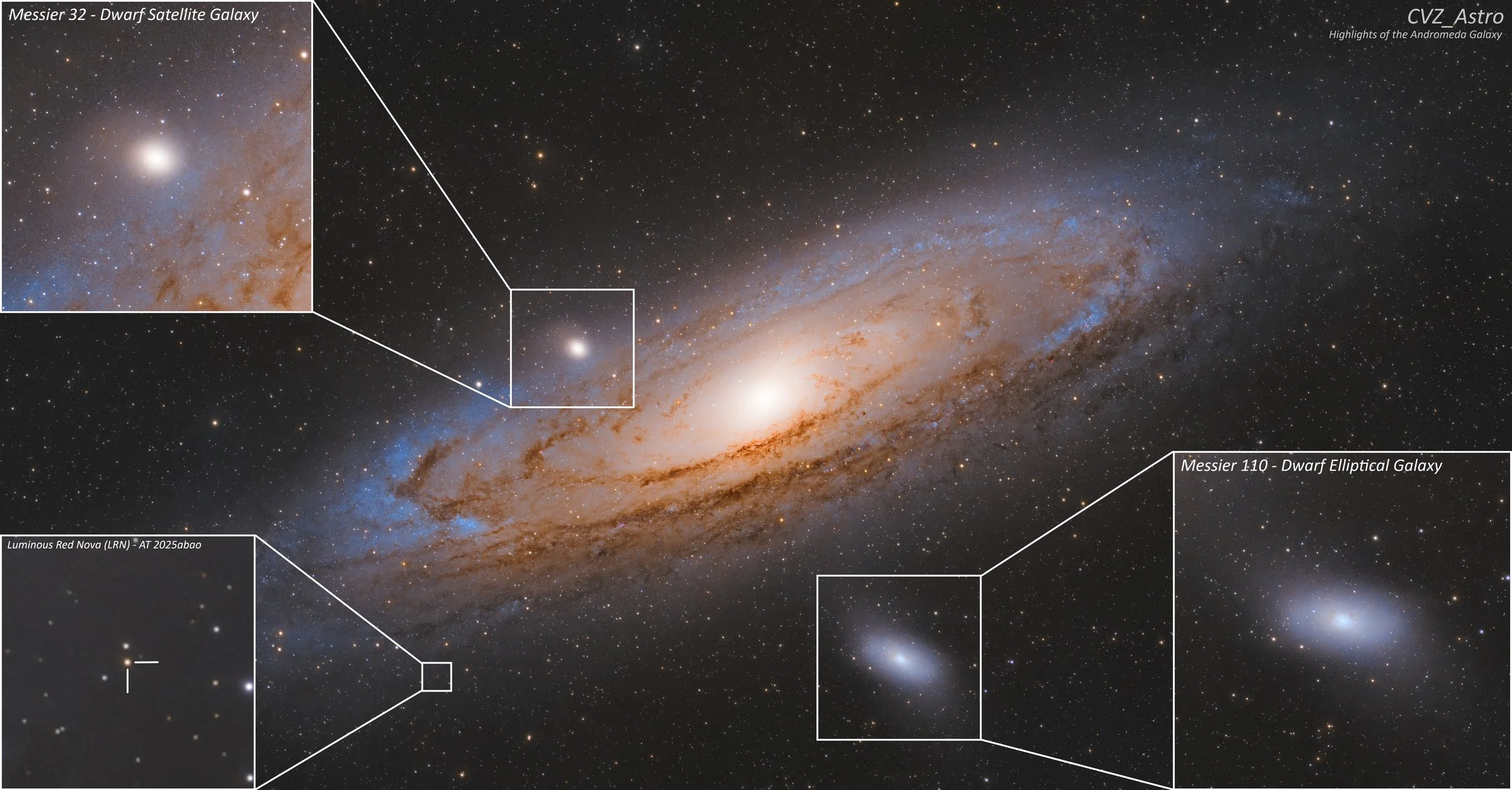
Highlights of the Andromeda Galaxy
Acquisition details:
Optolong UV/IR Cut lights:
Panel 1-1: 49x 180sec
Panel 1-2: 48x 180sec
Panel 2-1: 45x 180sec
Panel 2-2: 42x 180sec
In total: 9hr and 12min
Calibration frames for each night and panel:
20 Darks
20 Flats
20 Biases
Bortle: 5
Gear used:
🔭 Askar 103APO
⚙️ Sky-Watcher EQ6-R Pro
📸 ZWO ASI2600MC AIR
🌌 Optolong UV/IR Cut