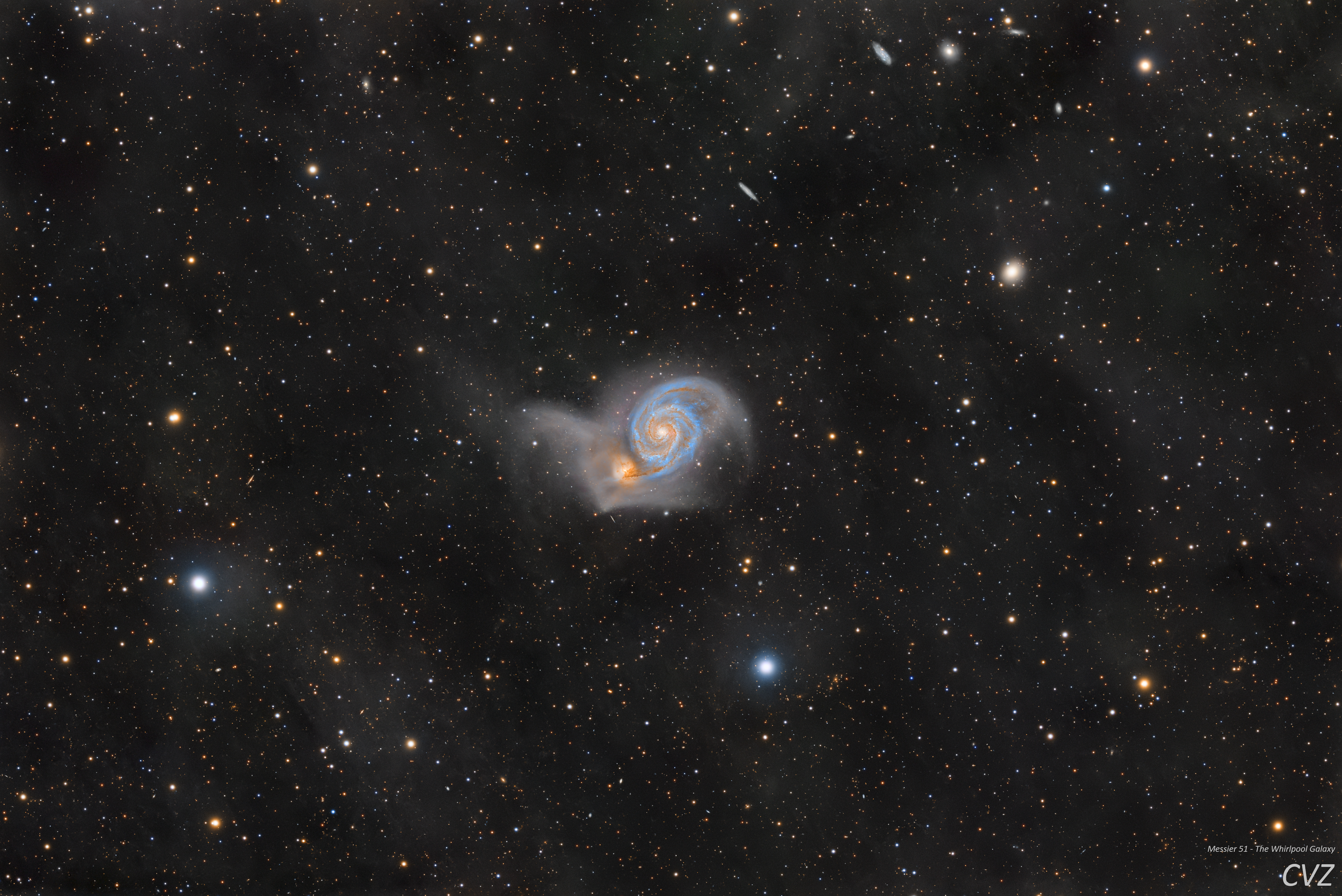

Messier 33 - The Triangulum Galaxy
Messier 33, also known as the Triangulum Galaxy, is located at a distance of approximately 3 million light-years from Earth. It lies in the constellation Triangulum and has an apparent magnitude of about 5.7. The first well documented written observation of this galaxy was made by Charles Messier in 1764. However, there has been speculation that the Sicilian astronomer Giovanni Battista Hodierna may have observed and described it earlier a lot earlier in 1654. Hodierna wrote about a nebula in the somewhere around the constellations Andromeda and Triangulum, but the coordinates he provided were not precise enough to conclusively identify the object as Messier 33. He described it as a nebula visible to the unaided eye or through a small telescope, without resolved stars. This sounds quite similar to the early descriptions of other galaxies, such as Messier 31, the Andromeda Galaxy. So it might be possible that Hodierna was the first to record this object.
One aspect of the Triangulum Galaxy that I like is its orientation, we observe it almost face on. Because of its relatively close to us this angle allows us to capture a lot of detail in the galaxy. One of the most notable features is the star forming region NGC 604, which is known to be the largest HII region in the entire Local Group, of which the Milky Way is a member. The young, massive stars within this region ionize the surrounding gas, causing the nebula to glow strongly in hydrogen-alpha emission.
To capture this galaxy, I used an Optolong L-Pro light pollution filter in order to preserve the galaxy’s natural colours. However, I had one small problem in the stacked image. At the time, I had recently bought a new telescope, the Askar 103 APO, and it turned out that the dithering settings in the ASIAIR required a higher value compared to those used with my William Optics RedCat 51 MK 2.5. I did not know this at the time, which resulted in a lot of walking noise in the stack.
Toward the end of 2026 and the beginning of 2027, I would like to revisit this galaxy. I plan to photograph Messier 33 using my broadband UV/IR cut filter in combination with my newer SHO dualband filters, the Optolong L-eXtreme and L-Synergy. I can not wait to start that project, I have seen some amazing images from other amateur astrophotographers in the recent years!
Acquisition details:
Optolong L-Pro lights:
0hr 30min
10x 180sec
Calibration frames:
20 Darks
20 Flats
20 Biases
Bortle: 5
Gear used:
🔭 Askar 103APO
⚙️ Sky-Watcher EQ6-R Pro
📸 ZWO ASI2600MC AIR
🌌 Optolong L-Pro