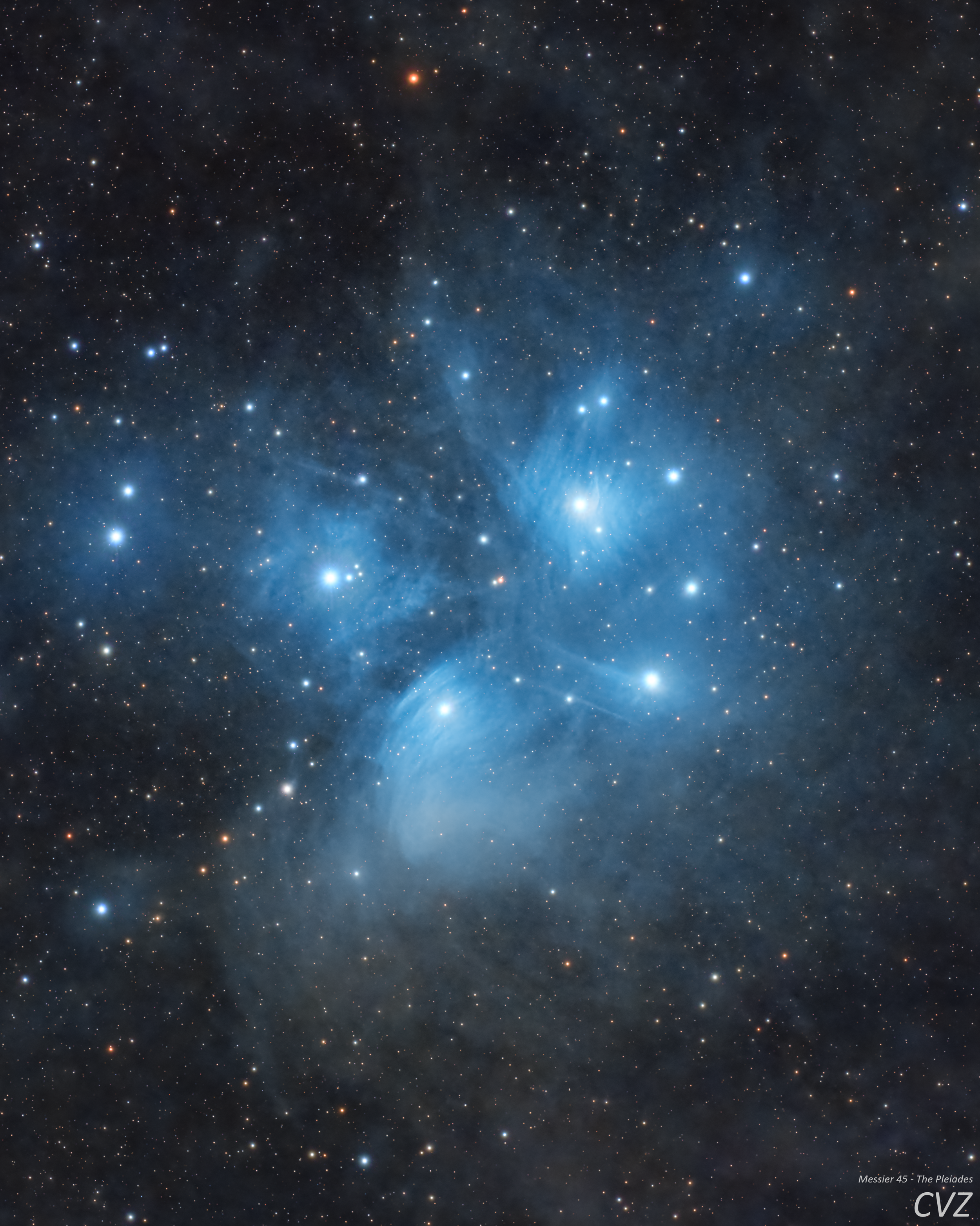
Messier 45 - The Pleiades, also known as The Seven Sisters
Messier 45, also known as the Pleiades or the Seven Sisters, is one of the most well known open star clusters in the night sky. In Dutch, it has a rather poetic name “Het Zevengesternte”, which roughly translates to seven-star constellation. This open cluster is located in the constellation Taurus, at a distance of about 440 light-years from Earth. The last time I wrote a blog post about this cluster, I mentioned that it contained a few hundred stars, but that information is now outdated. I recently read an article on www.space.com stating that some of the stars surrounding the Pleiades have also been confirmed as members of the cluster. This means the Pleiades now contains over 3,000 stellar members, making it a whopping 20 times larger than originally thought!
When I first learned about this open cluster, I assumed the surrounding nebula was part of the cluster itself. Since the Pleiades is relatively young, only about 100 million years old, I thought that perhaps not all the gas and dust had yet become dense enough to trigger star formation. However, this dust does not originate from the cluster. Based on velocity measurements of both the nebula and the stars, scientists have discovered that the nebula is actually a passing interstellar cloud drifting through the region. We just happen to be observing this encounter at the right moment, resulting in the beautiful reflection nebula we see today.
IC 349 Barnard’s Merope Nebula
The seven main stars of the Pleiades are named Maia, Electra, Taygeta, Celaeno, Asterope, Alcyone, and Merope. Several of these stars have something special associated with them. For example, Maia is surrounded by a faint, diffuse reflection nebula known as NGC 1432, and Merope is accompanied by a similar diffuse nebula which is known as NGC 1435.
However, Merope has something even more interesting. Very close to the star lies a small, compact reflection nebula only about 3,500 astronomical units (AU) across. This object was discovered by Edward Emerson Barnard in 1890, who described it as “a new comparatively bright, round cometary nebula, close south and following Merope”. The nebula is designated IC 349 and spans just 33 arcseconds, which is remarkably small. I’m honestly surprised it is visible at all in my William Optics Redcat 51 MK2.5 data, especially considering the telescope’s modest 250 mm focal length.
Because IC 349 lies so close to the bright star Merope, it is easily overwhelmed when stretching the data. To compensate for this, I created a separate edit focusing solely on this region to better reveal the nebula. Interestingly, it wasn’t until a full year after finishing my main Pleiades image that I read about IC 349 in someone else’s Instagram post. Its existence surprised me so much that I immediately opened PixInsight to check whether I had captured it as well.
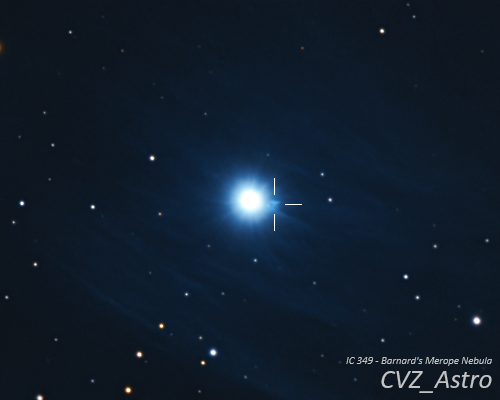
IC 349 - Barnard’s Merope Nebula
The Nebra Sky Disc
The Pleiades have an apparent magnitude of 1.6, making it the brightest Messier object in the entire catalog. They are also the closest Messier object to Earth. Because of this, humanity has known about this open cluster for thousands of years. In Australia and France, cave paintings have been found that may depict the Pleiades and are thought to be over 10,000 years old.
However, the story I want to share wiht you comes from a much later time. In 1999, near the village of Nebra in Germany, two illegal treasure hunters discovered a bronze disc about 30 centimeters in diameter using their metal detectors. The disc was decorated with gold inlaid symbols, and nearby they also found two bronze swords, two bronze axes, fragments of bracelets, and a chisel. The golden symbols on what is now known as the Nebra Sky Disc depict several celestial objects, including the Sun, the Moon, stars and notably, the Pleiades!
As mentioned earlier, the disc was found illegally. The two treasure hunters sold it to a dealer for 31,000 Deutsche Marks, but were later sentenced to prison in 2003 for their actions. The discovery was initially met with skepticism by scholars and scientists, but after extensive research it is now widely accepted as authentic.
If you would like to see the Nebra Sky Disc for yourself, you can! It is permanently displayed at the State Museum of Prehistory in Halle, Germany. I would love to visit one day and see this remarkable artifact in person.
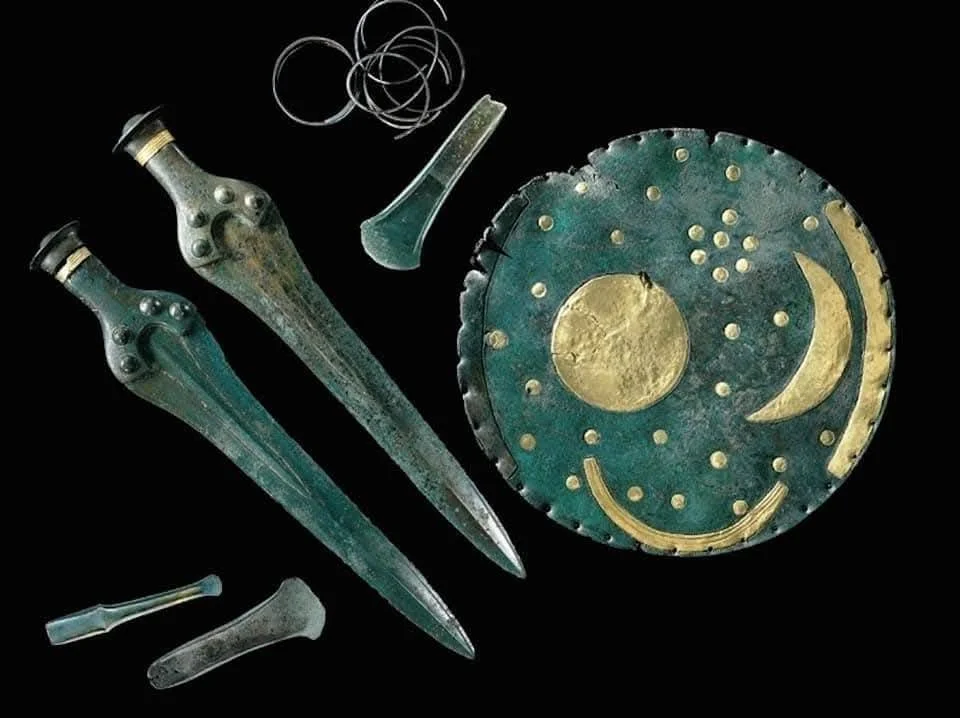
The Nebra Sky Disc (source: Halle Museum, Germany)
Acquisition details:
Calibration frames:
20 Darks
20 Flats
20 Biases
Optolong L-Pro lights:
4hr 30min
90x 180sec
Bortle: 5
Gear used:
🔭 Askar 103APO
⚙️ Sky-Watcher EQ5 Pro
📸 ZWO ASI294MC Pro
🌌 Optolong L-Pro
My previous edit of this Pleiades data

Messier 45 - The Pleiades, photographed using my William Optics Redcat 51 MK2.5 telescope and ZWO ASI294MC PRO cooled deep-sky camera