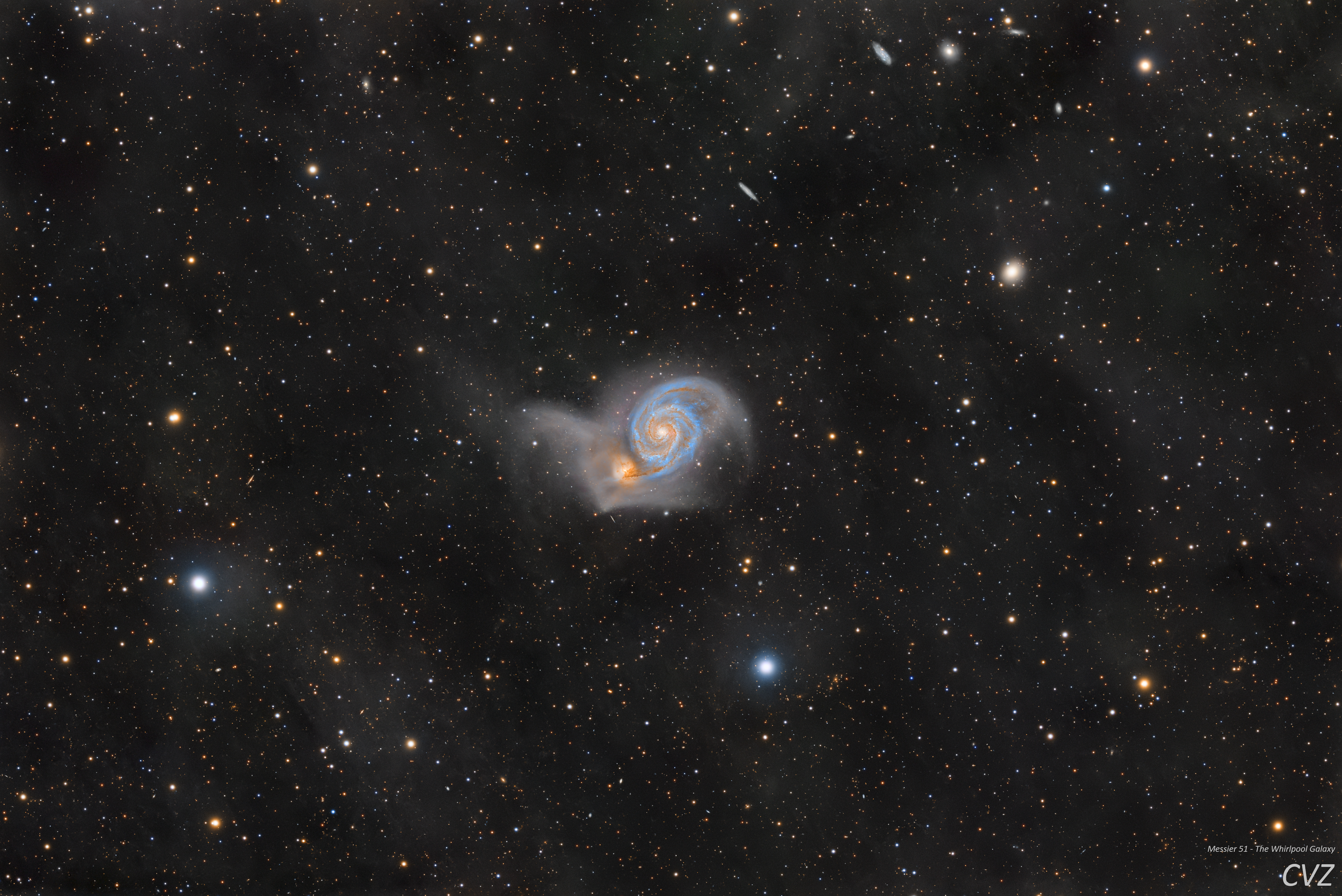
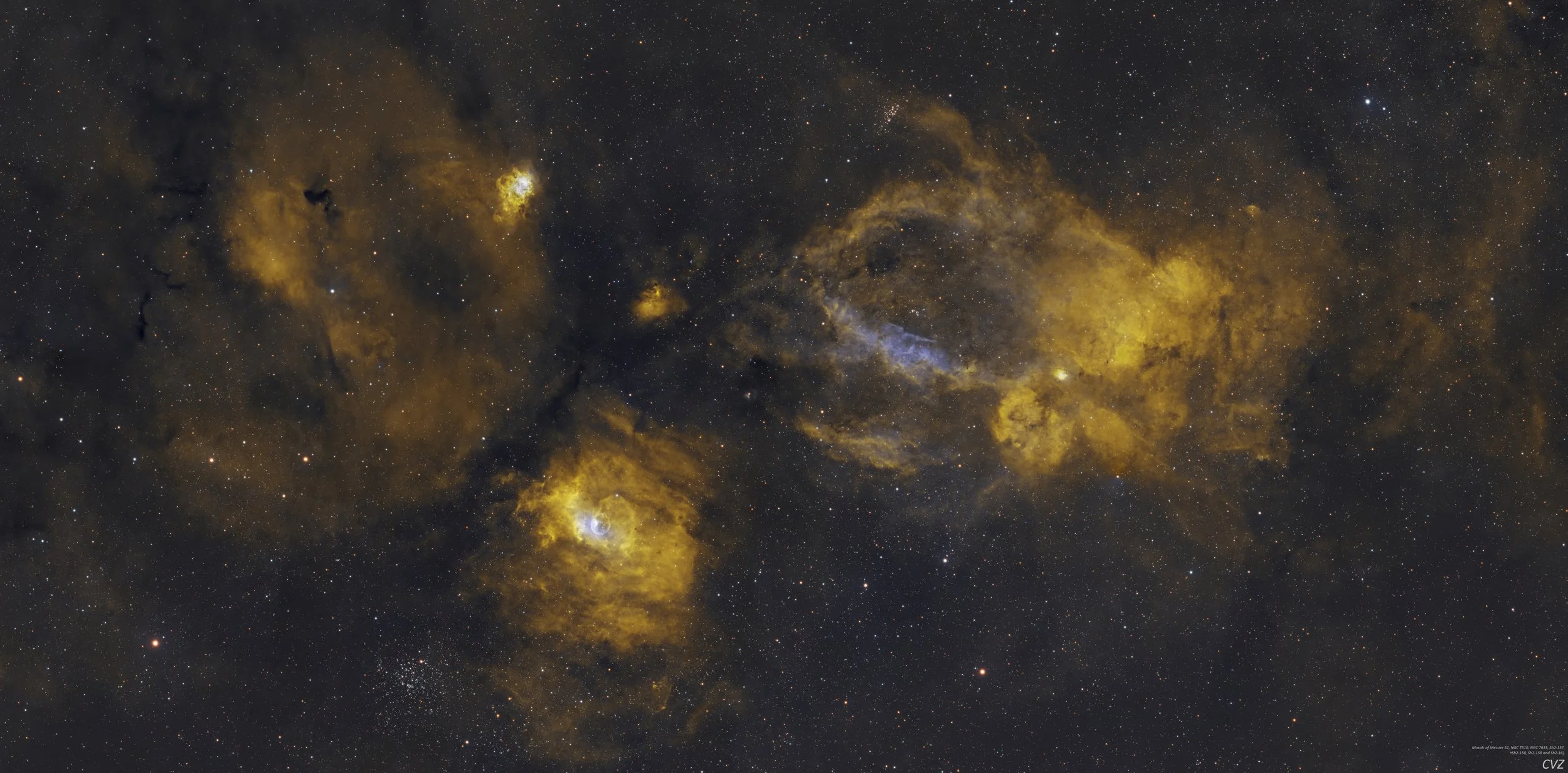
Messier 52 - The Scorpion Cluster and its Sh2-friends
My first mosaic
For this project I stepped away from my usual way of working and created my very first mosaic, stitched together from four individual panels. Processing and combining a mosaic is a genuinely different process compared to editing a single image. Instead of working on one image, you are editing separate datasets that each need to be calibrated, stretched, and colour balanced in a way that stays consistent with its neighbours, before they can even be blended together into one seamless final image. I found the whole process really interesting to learn, from carefully researching with mosaic scripts to use, to making sure the transitions between them stayed invisible. Unfortunately the weather did not fully cooperate during this project, which left me with less total integration time than I had originally planned. Even so for a first attempt at a mosaic, I am quite happy with the result, and this is definitely a type of project I want to return to more often in the future.
To gather the data, I used my Optolong L-eNhance filter across all four panels, collecting both hydrogen-alpha (Ha) and Oxygen III (OIII) signal. Afterwards, I used the Perfect Palette Picker script from the SetiAstro in PixInsight to recombine that Ha and OIII data into a full synthetic SHO palette, giving the final mosaic that classic narrowband colour contrast even though only two filters were actually used to collect the data.
This widefield happens to capture an entire neighbourhood of interesting objects tucked into the border between Cassiopeia and Cepheus. The open cluster Messier 52, the Bubble Nebula, the Lobster Claw Nebula, and a trio of fainter Sharpless nebulae that rarely get much attention on their own.
Messier 52, the Scorpion Cluster
Messier 52 is a bright open cluster located in the constellation Cassiopeia at a distance of roughly 4,600 to 5,000 light-years. It was discovered by the Italian astronomer Giovanni Hodierna before 1654, and later independently catalogued by Charles Messier in 1774, reportedly while he was tracking a comet through this part of the sky. The cluster is relatively young, with age estimates ranging from around 35 million up to nearly 160 million years depending on the source, and it contains several hundred to a few thousand stars packed into a compact, richly populated group, including a number of hot blue B-type giants and supergiants that make it quite bright for its distance.
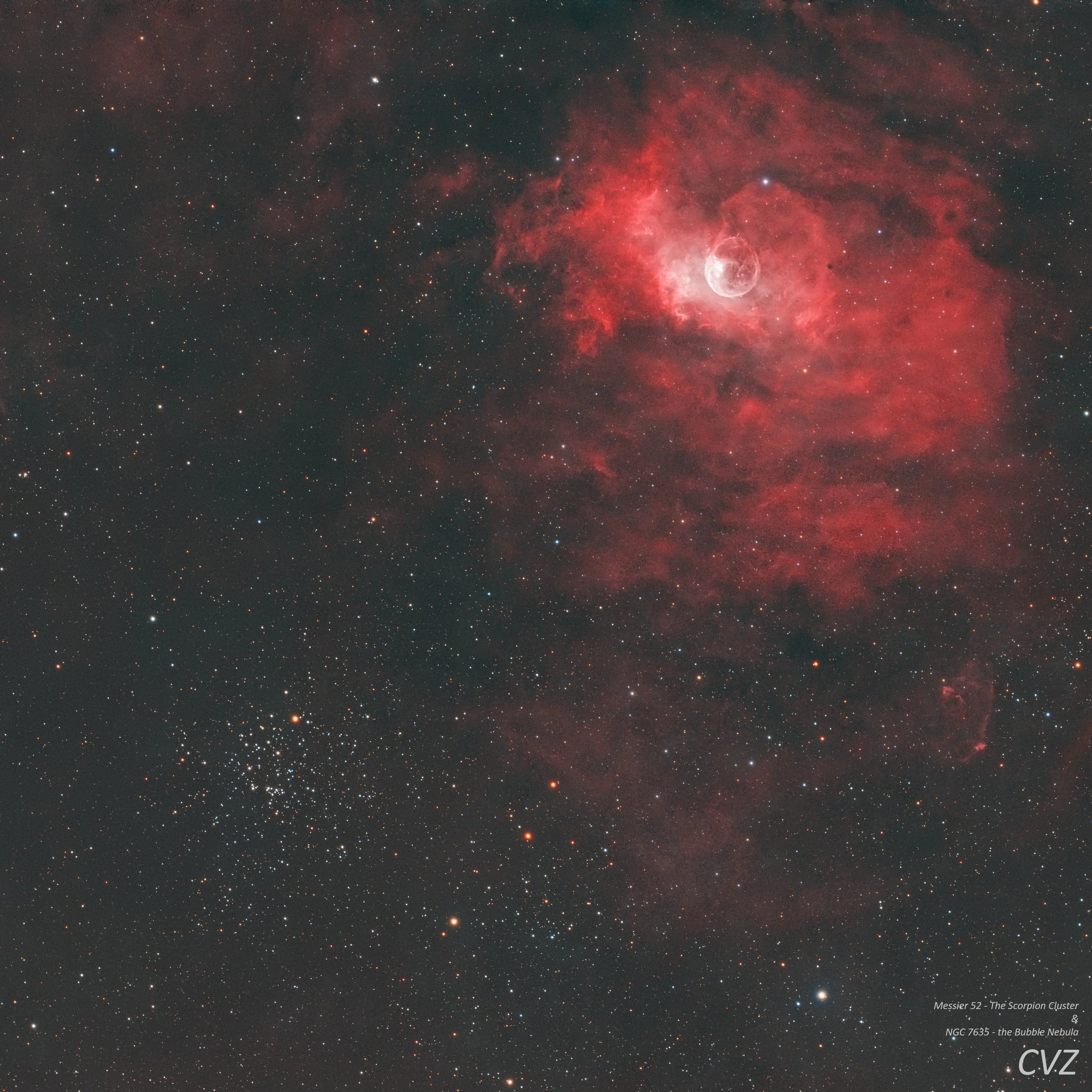
Messier 52, the neighbour of the Bubble Nebula
NGC 7635, the Bubble Nebula
Just south of Messier 52 lies NGC 7635, also known as the Bubble Nebula, and also catalogued as Sharpless 162. Located somewhere between 7,100 and 11,000 light-years away from our planet, depending on the source, this nearly perfect sphere of glowing gas is being carved out by the intense stellar wind of a single massive star, BD+60 2522, an O-type giant with roughly 10 to 20 times the mass of our sun. This star is blasting out material at speeds of well over a thousand kilometers per second, and where that wind slams into the surrounding molecular cloud, it compresses the gas into the thin, glowing shell that gives the nebula its name. The bubble itself spans somewhere around 7 to 10 light-years across, and interestingly it is not a perfectly symmetric sphere. Oon one side the shell appears flattened and distorted, evidence of it pushing into a denser pocket of the surrounding cloud that is resisting its expansion.
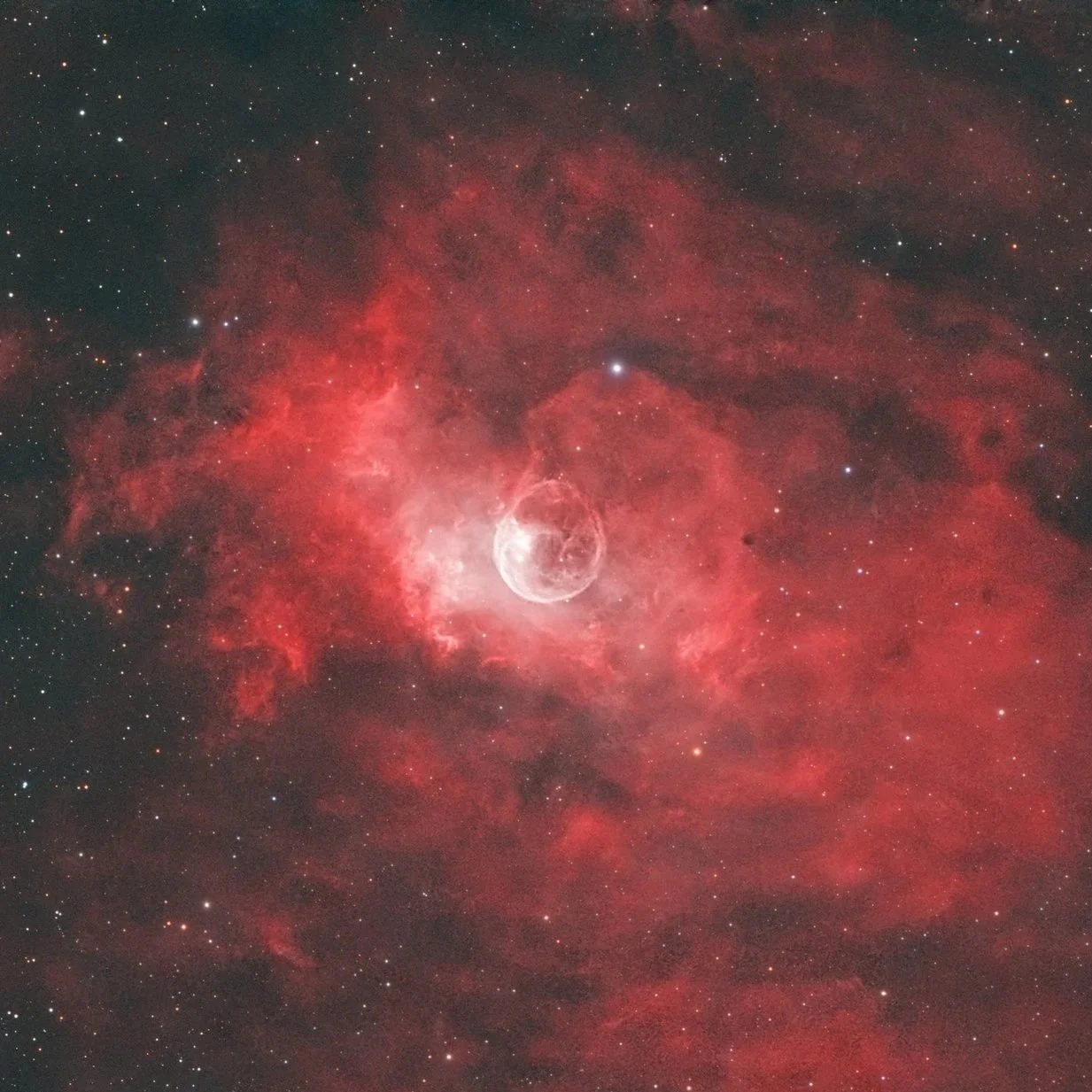
NGC 7635 - The Bubble Nebula in HOO
Sh2-157, the Lobster Claw Nebula
To the south of the Bubble Nebula lies Sharpless 157, also known as the Lobster Claw Nebula because of its curved, claw-like shape. Distance estimates for this object vary quite a bit online and in my astrophotogaphy atlas, ranging anywhere from about 8,000 to over 16,000 light-years, with many modern sources settling somewhere around 11,000 light-years. The nebula forms part of the Cassiopeia OB2 association, a large grouping of hot, massive O and B-type stars whose combined radiation and stellar winds have sculpted the northern part of the cloud into a ring-like shape. That structure is largely attributed to the young Wolf-Rayet star WR 157, embedded within the nebula, whose extreme winds carve out the curved cavity that gives the Lobster Claw its name. The small open cluster NGC 7510 also sits just at its edge, adding another point of interest to this already busy corner of sky.
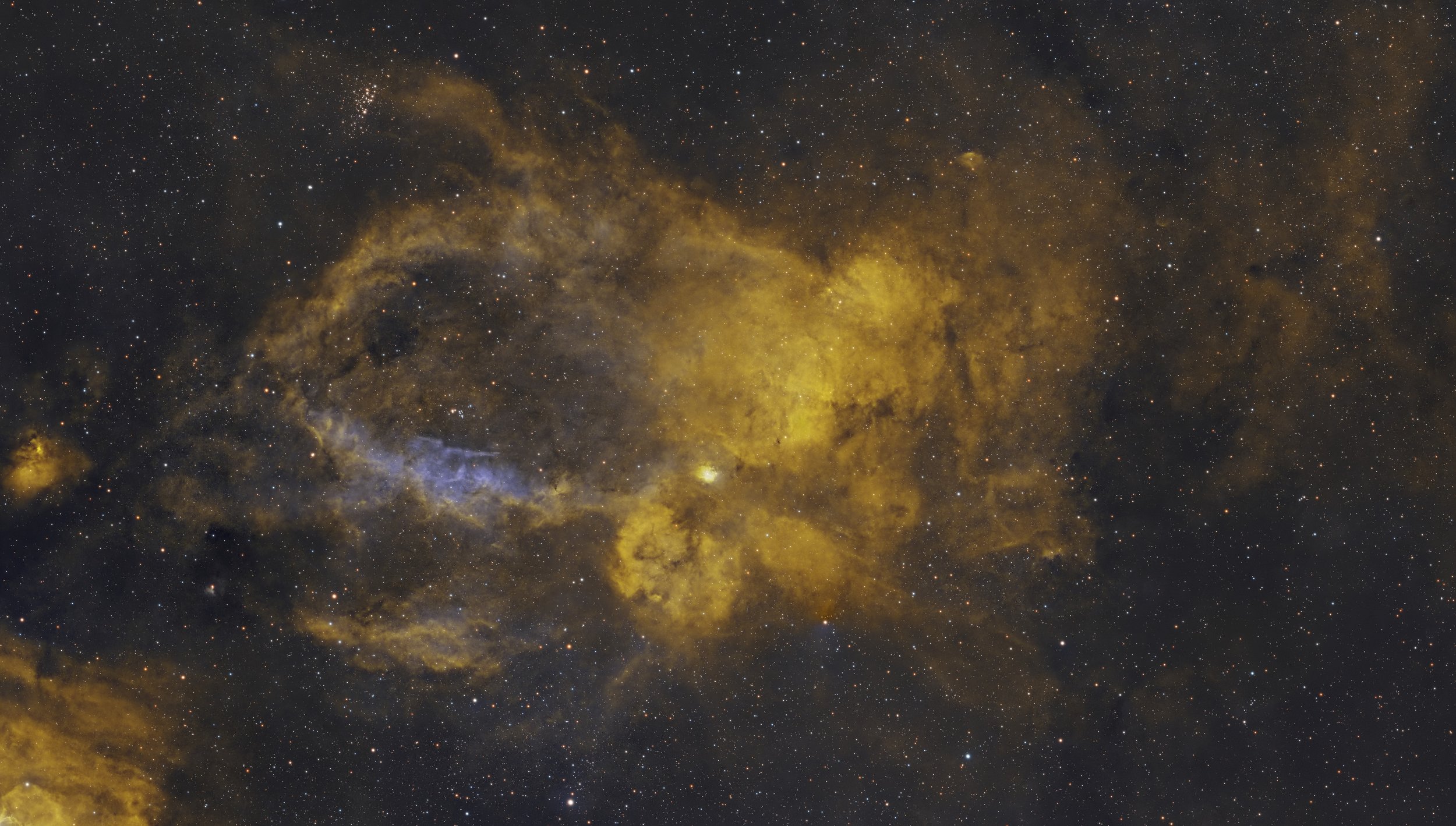
Sh2-157 - The Lobster Claw Nebula in SHO
Sh2-158, the Northern Lagoon Nebula
Also known as NGC 7538, Sharpless 158 lies at a distance of approximately 9,100 light-years, technically just across the border in the constellation Cepheus. This region is a genuinely remarkable site of active star formation, and it is home to one of the largest protostars ever discovered, an object still in the earliest stages of stellar birth that spans roughly 300 times the size of our entire solar system. The nebula is ionized primarily by the hot O-type star NGC 7538 IRS 6, along with several other massive young stars embedded within it, and the region hosts numerous infrared sources that mark out pockets of ongoing star formation hidden deep within its dust.
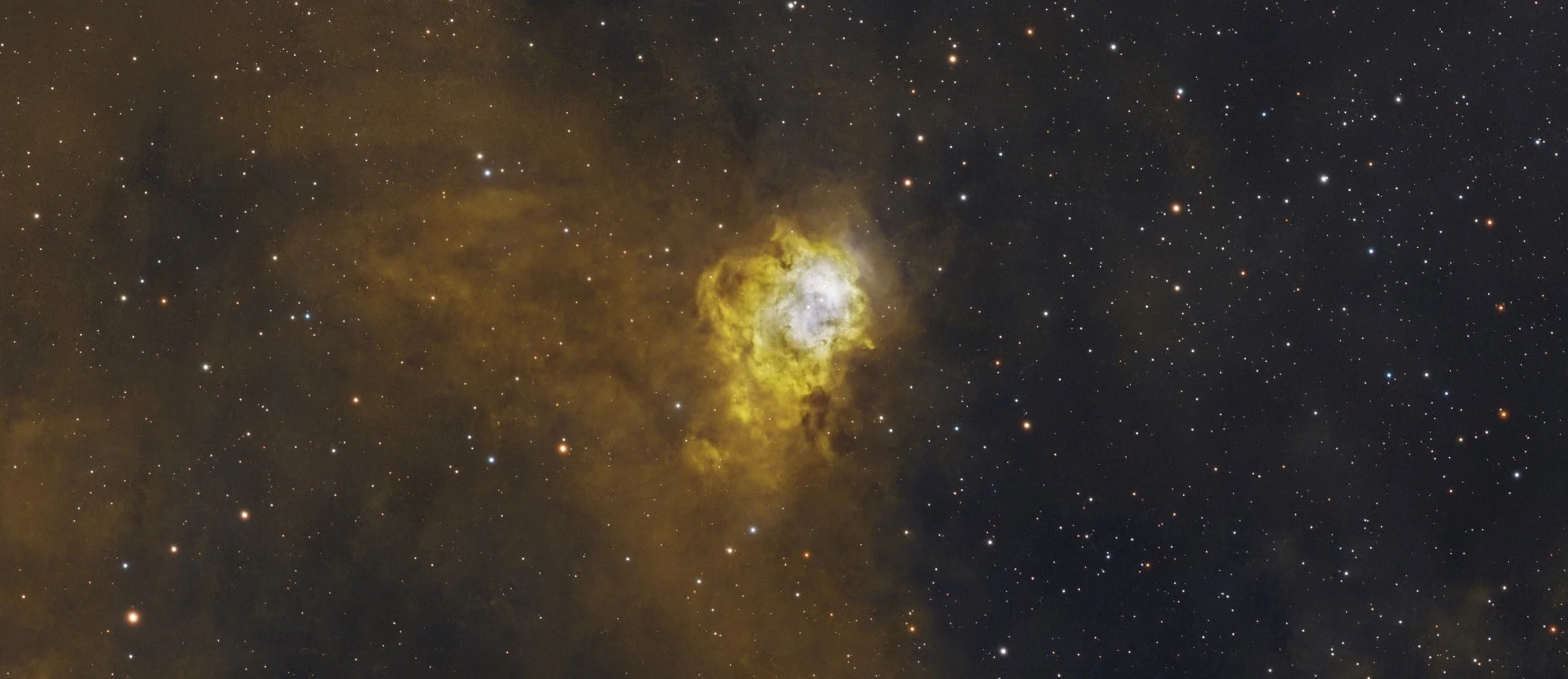
Sh2-158 - The Northern Lagoon Nebula in SHO
Sh2-159
Sh2-159 is a much fainter emission nebula that sits almost directly beside the Bubble Nebula, and it is easy to see why it rarely gets attention of its own. Most images of NGC 7635 capture Sh2-159 only as an incidental bystander drifting into the corner of the frame (,just like mine haha). Together with Sh2-158, it is embedded within the same enormous molecular cloud, an object with a combined mass of around 595,000 times that of our sun, and the entire structure is in turn wrapped inside the much larger diffuse nebula Sh2-161. In many ways, Sh2-159 is a nice reminder that even the quiet, overlooked corners of a busy field like this one still have their own story to tell.
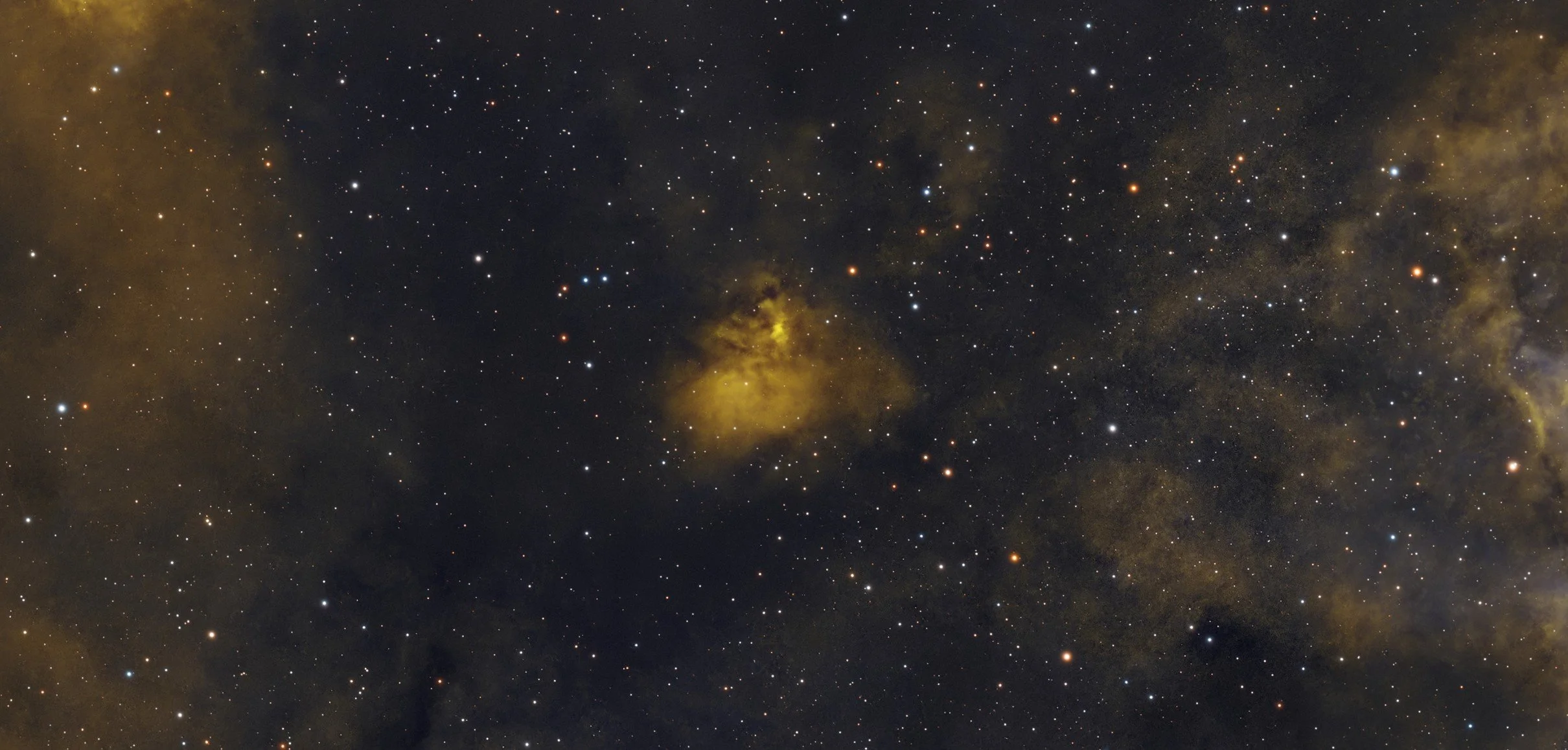
Close-up of Sh2-159
Sh2-161
The last one! Sh2-161 is the faint, extended diffuse nebula that wraps around and connects this entire region, containing both Sh2-158 and Sh2-159 within its much larger boundary. Compared to its brighter neighbours, it lacks a distinct nickname and rarely takes center stage in an image, but it forms the faint glowing backdrop that ties this whole corner of Cassiopeia and Cepheus together, and it was actually one of the more rewarding structures to try to pull out of the data during processing, especially with those dark dusty clouds
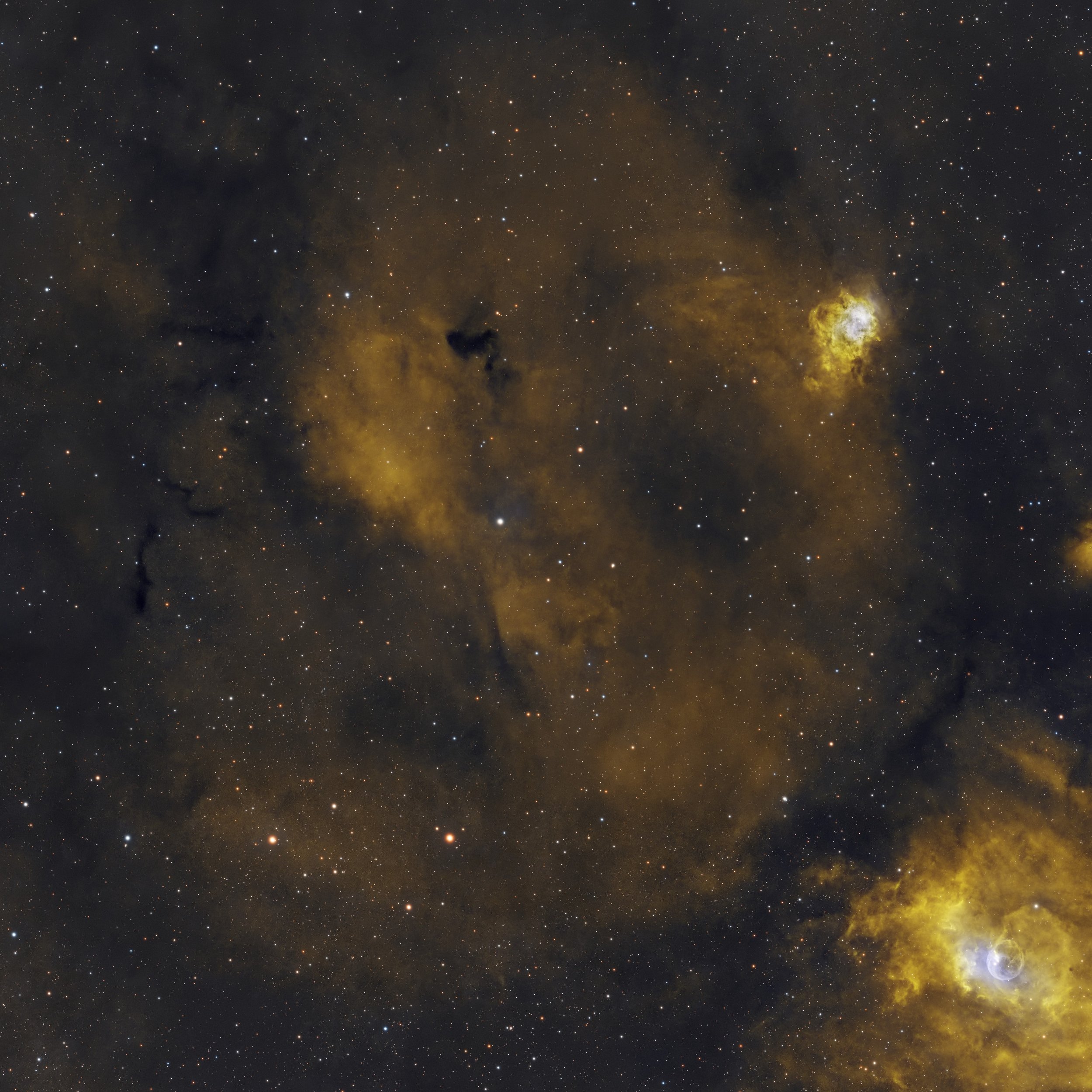
Close-up of Sh2-161
Bringing together six different objects across four mosaic panels made this a really fun project, and even with less integration time than I had hoped for, I feel like this first mosaic captured the character of this incredible part of the sky. I am already looking forward to the next mosiac project!
Acquisition details:
Optolong L-eNhance lights:
Panel 1-1: 40x 180sec
Panel 1-2: 35x 180sec
Panel 2-1: 33x 180sec
Panel 2-2: 23x 180sec
In total: 6hr and 33min
Calibration frames:
20 Darks
20 Flats
20 Dark flats
Bortle: 5
Gear used:
🔭 Askar 103APO
⚙️ Sky-Watcher EQ6-R Pro
📸 ZWO ASI2600MC AIR
🌌 Optolong L-eNhance 2”