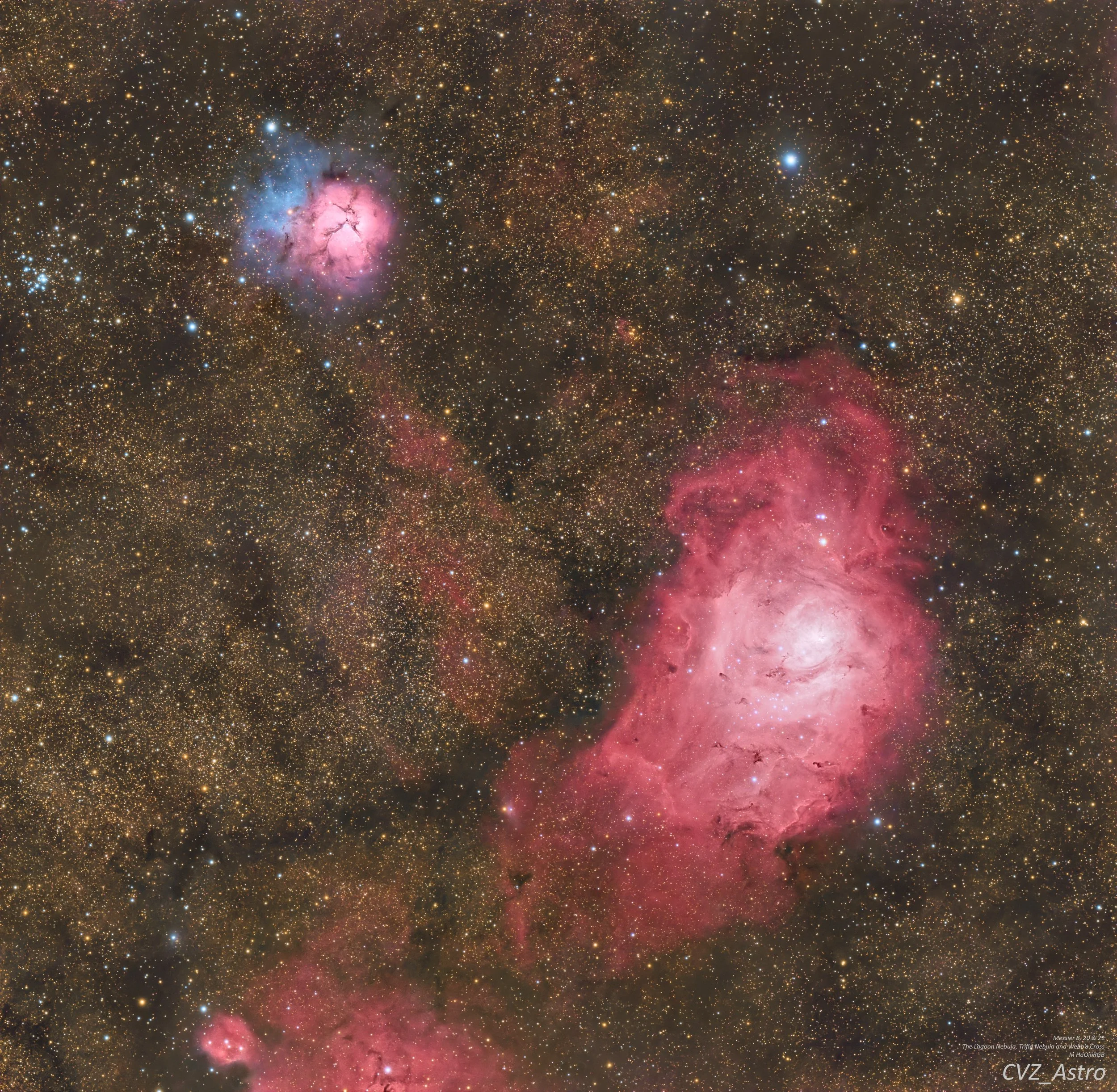
Messier 8, 20 and 21 - The Lagoon Nebula, Trifid Nebula and Webb’s Cross in HaOiiiRGB
One image, three objects
Sagittarius during the summer months, is home to one of the richest and most rewarding regions of sky an astrophotographer can point a telescope at. In this image three separate Messier objects are visible together. Messier 8, the Lagoon Nebula, Messier 20, the Trifid Nebula, and Messier 21, also known as Webb's Cross. All three lie within just a few degrees of each other in the constellation Sagittarius, close to the direction of the galactic core, which is exactly why this part of the sky is so densely packed with stars, gas, and dust.
To capture this field, I traveled to a nearby dark sky location on three separate nights, away from the light pollution of my usual imaging spot. My original plan was to create a broadband only image of this region. I had recently seen the first image released from the Vera Rubin Observatory of this same area of sky, showing thousands of golden coloured stars scattered across the frame, and I wanted to try to recreate something similar with my own equipment. For the first two nights I used my Optolong UV/IR Cut filter to gather that broadband data, slowly building up the star field and the natural colours of the region. On the third night, I decided to add a session with my Optolong L-eNhance filter as well. This filter isolates the hydrogen-alpha (Ha) and oxygen III (OIII) signal, and adding this data allowed the Lagoon and Trifid Nebulae to stand out more clearly against the sea of golden stars, without losing the broadband character I originally set out to capture. I am very happy with how this image turned out. It really does feel like a nice middle ground between a broadband deepfield and a more traditional narrowband enhanced nebula image.
The Lagoon and the hourglass
Messier 8 is a large emission nebula located at a distance of roughly 4,100 light-years away from Earth, and it spans an enormous area of the sky, more than a hundred light-years across. It was first observed by the Italian astronomer Giovanni Hodierna somewhere before 1654, long before Charles Messier added it to his catalogue in 1764. The nebula gets its name from the dark, lagoon like dust lane that appears to cut across the glowing gas, separating it into a brighter eastern half and a fainter western half. Embedded within the nebula is the young open cluster NGC 6530, only around two million years old. Whose hot, massive stars are responsible for ionizing the surrounding hydrogen gas and giving the nebula its characteristic reddish glow.
What makes the Lagoon Nebula especially interesting scientifically is how actively it is still forming stars today. Scattered throughout the cloud are small, dark, collapsing clumps of gas and dust known as Bok globules, some only about 10,000 astronomical units across, that are essentially stellar embryos still in the process of contracting into new stars. I see these a lot in my images of emission nebula, and I wish I had a bigger telescope to capture more detail in those, they look cool!
At the heart of Messier 8 lies a small, intensely bright region known as the Hourglass Nebula. This structure is shaped and illuminated primarily by Herschel 36, a hot O-type star whose powerful ultraviolet radiation and stellar winds are sculpting the surrounding gas into the twisted, hourglass like form we see today. Compared to the rest of the nebula, this region is remarkably compact, only about half a light-year across, yet it is one of the most active and dynamic corners of the entire complex, and it is one of the areas I really enjoyed pulling detail out of during processing.
To make the Hourglass Nebula really stand out, I edited the entire image a second time, focusing solely on the Hourglass Nebula.
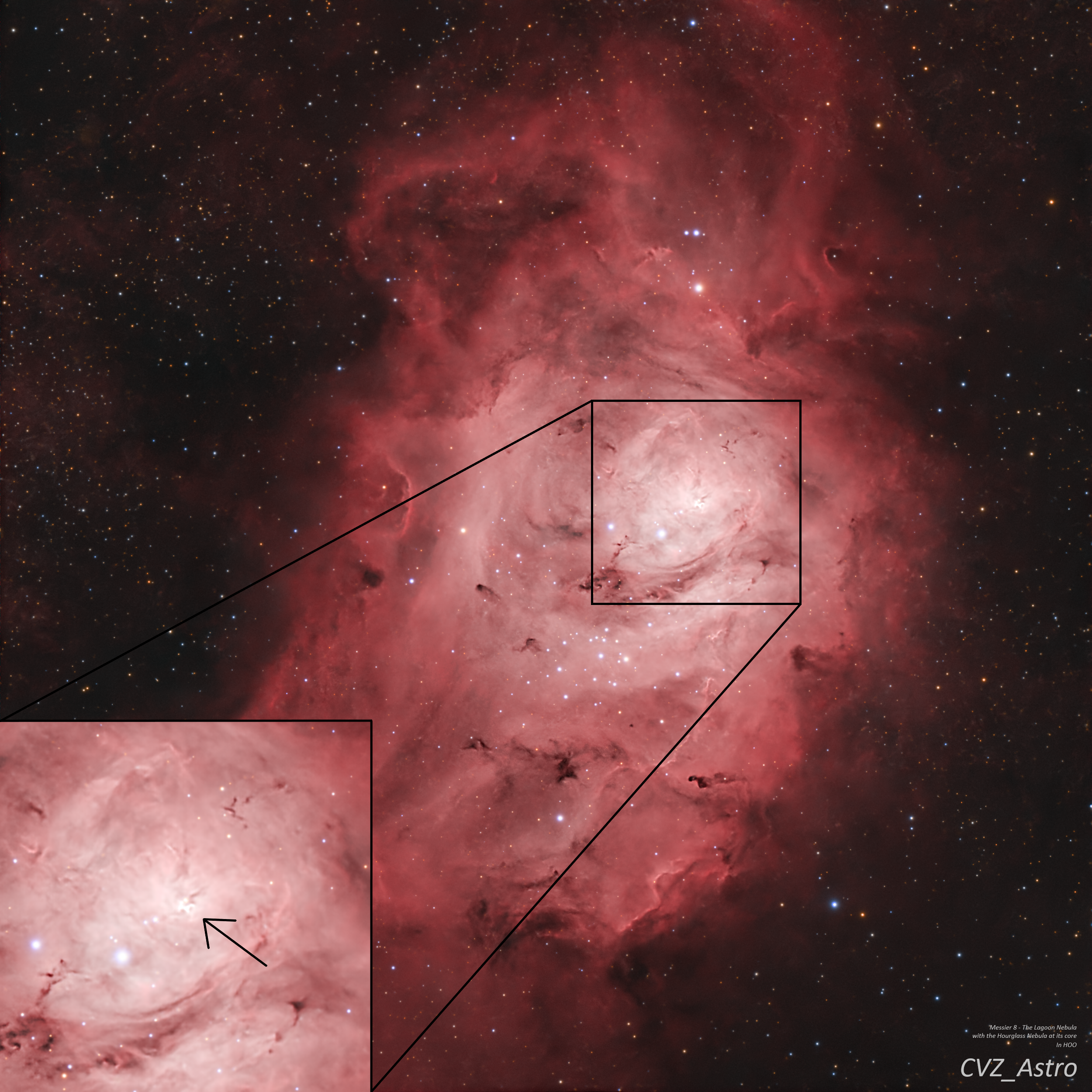
Close-up of the Hourglass in Messier 8
The Trifid Nebula
A couple of degrees to the northwest of the Lagoon Nebula lies Messier 20, the Trifid Nebula, located at a distance of roughly 5,000 light-years and spanning about 40 light-years across. At an age of only around 300,000 years, it is one of the youngest star-forming regions visible in our night sky! The nebula owes its name to the three dark lanes of dust, catalogued separately by Edward Emerson Barnard as Barnard 85, that appear to trisect the glowing gas into three distinct nebulae. These lanes are not empty gaps, but dense, cold clouds of dust right in front the brighter nebula behind them, and in some models they are thought to be a result of earlier supernova explosions from short lived massive stars that formed in the same region.
What I find fascinating about the Trifid is that it packs three completely different types of nebulae into one object! The reddish glow at its core is a classic emission nebula, ionized by the hot O-type star HD 164492A. Around the edges, a soft blue reflection nebula appears, created by starlight scattering off fine dust particles rather than the gas itself glowing. And then there is the dark nebula, the dust lanes that give the Trifid its name and its unmistakable shape. Infrared observations with the Spitzer Space Telescope have revealed that hidden within this dust are dozens of massive protoplanetary disks and well over a hundred smaller newborn stars, completely invisible in a regular visible light image like mine, which really drives home how much active star formation is still happening behind that curtain of dust.
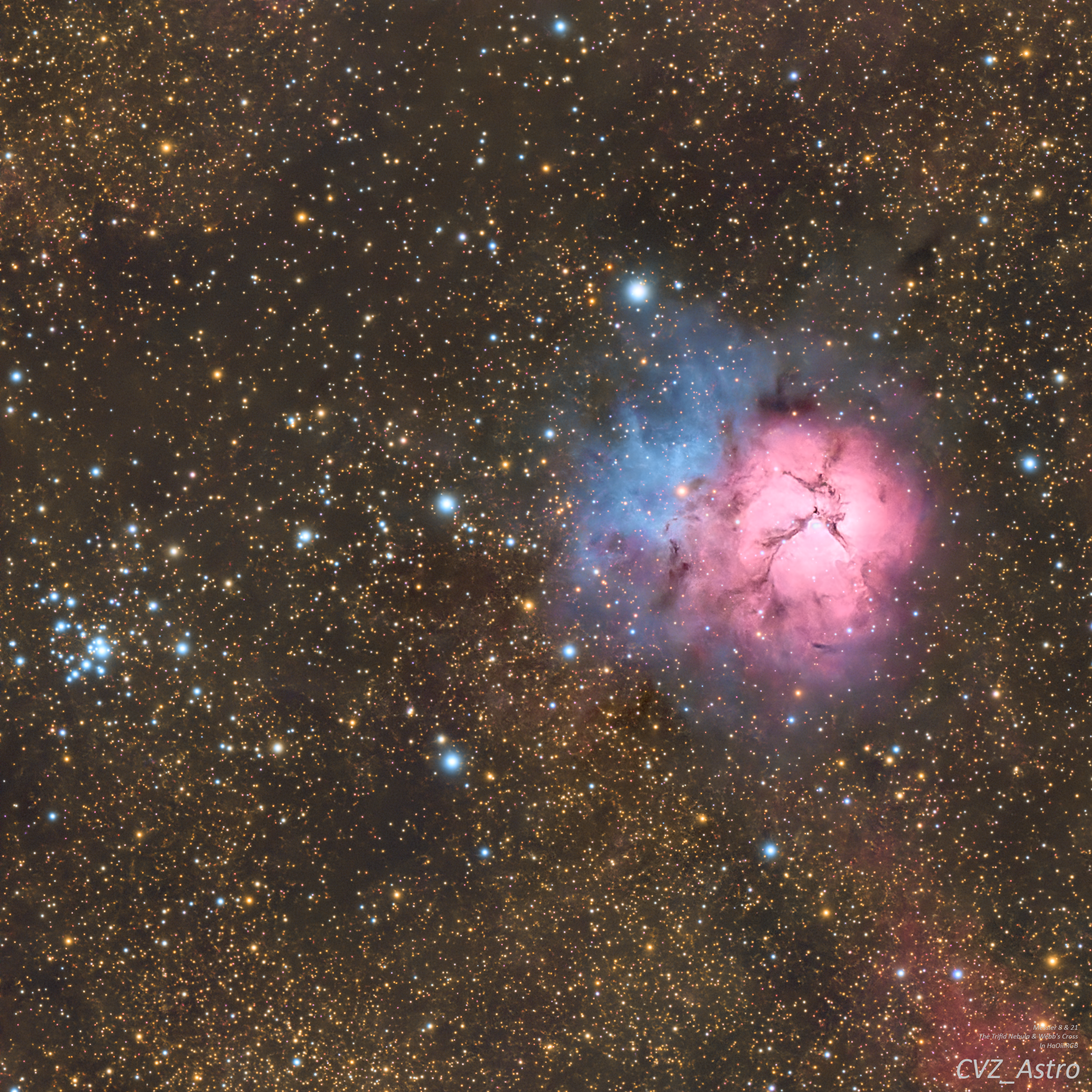
The Trifid Nebula (right)
Webb’s Cross an open cluster near the Trifid
Just northeast of the Trifid Nebula lies Messier 21, also known as Webb's Cross, a compact open cluster of young, hot stars. It was discovered by Charles Messier himself in June 1764, and although it shares the same field of view as the Trifid Nebula, the two objects are not physically related. Messier 21 lies considerably closer to us, with distance estimates ranging from around 2,200 to just under 4,000 light-years depending on the source, compared to the Trifid's roughly 5,000 light-years, so any apparent connection between them is purely a matter of perspective along our line of sight.
The cluster itself is relatively young, at an estimated age of only about 6.6 million years, and is composed mainly of small, faint stars with a handful of brighter blue giants standing out among them. Unlike the Lagoon and Trifid Nebulae, Messier 21 no longer shows any nebulosity of its own, since the gas it once formed from has long since dispersed or been blown away by the radiation and winds of its hottest members. Even so its tight, loosely scattered grouping of blue-white stars adds a really nice contrast against the softer glow of the surrounding nebulae in the wider frame.
Because Webb’s only just fitted in my Redcat’s field of view, I decided to make another seprate image of M21 using my Askar 103 APO telescope, just in case I miss some stars on the leftside of the image
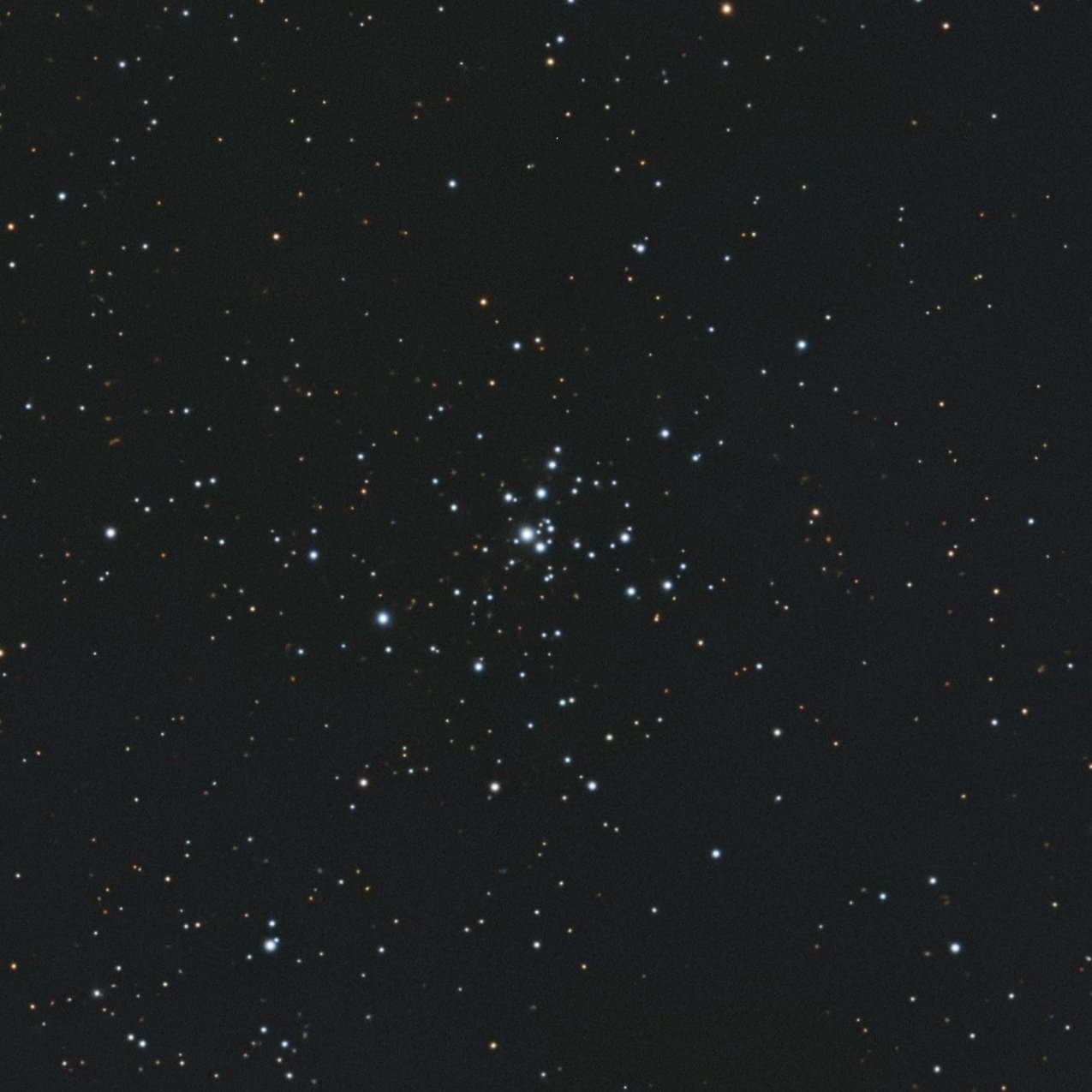
Webb’s Cross in broadband data
Bringing it all together, this image represents everything I love about widefield astrophotography. Three completely different types of deep-sky objects, a nebula shaped by a dark lagoon-like lane, a nebula split into three by dust, and a tightly packed cluster of stars, all captured in a single frame, surrounded by the golden glow of thousands of background stars from three nights spent under a dark sky.
Acquisition details:
Optolong UV/IR Cut lights:
4hr 40min
140x 120sec
Optolong L-eNhance lights:
2hr 30min
50x 180sec
In total: 7hr and 10min
Calibration frames (for each night):
20 Darks
20 Flats
20 Biases
Bortle: 5
Gear used:
🔭 William Optics Redcat 51 MK2.5
⚙️ Sky-Watcher EQ6-R Pro
📸 ZWO ASI533MC Pro
🌌 Optolong UV/IR Cut 2” & L-eNhance 2”