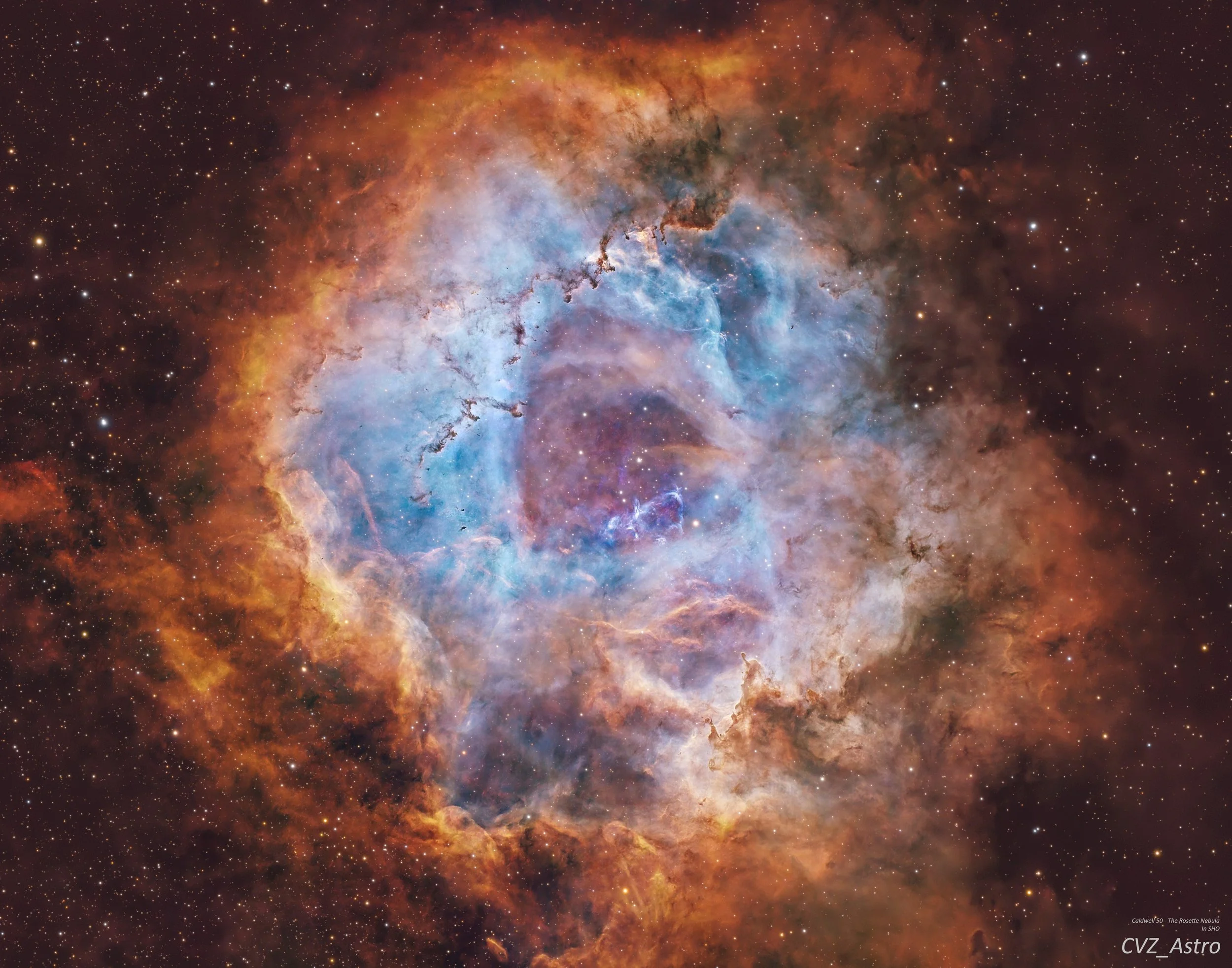
Caldwell 49&50 - The Rosette Nebula in SHO
Over the past few weeks, I have been working on the Rosette Nebula, and after 14.5 hours of total exposure time, I think I am finally done with it. For this image, I used two dualband filters, which makes it possible for astrophotographers like me to create an image with a color camera that captures hydrogen alpha (Ha), oxygen III (OIII), and sulfur II (SII). The result is this SHO image.
I expect I will revisit and reprocess this data quite a few times, since SHO offers so many possibilities when it comes to colour variations. In this version I gave Ha a red/orange tone and SII a yellow tone.
The Rosette Nebula is a nebula in the constellation Monoceros (the Unicorn) and is known as a stellar nursery. Stars are born here from the gas and dust within the nebula, which is clearly visible in the cluster of young stars in the open star cluster at its center, NGC 2244. Another interesting feature of this nebula is the band of dark, compact molecular dust and gas clouds that have not yet been fully dispersed by the intense radiation from the young stars. If you look closely the structures in this band resemble animals. One looks a bit like an elephant, and another like a donkey!
In the near future, I will write a longer and more in-depth description of this nebula. To be continued!
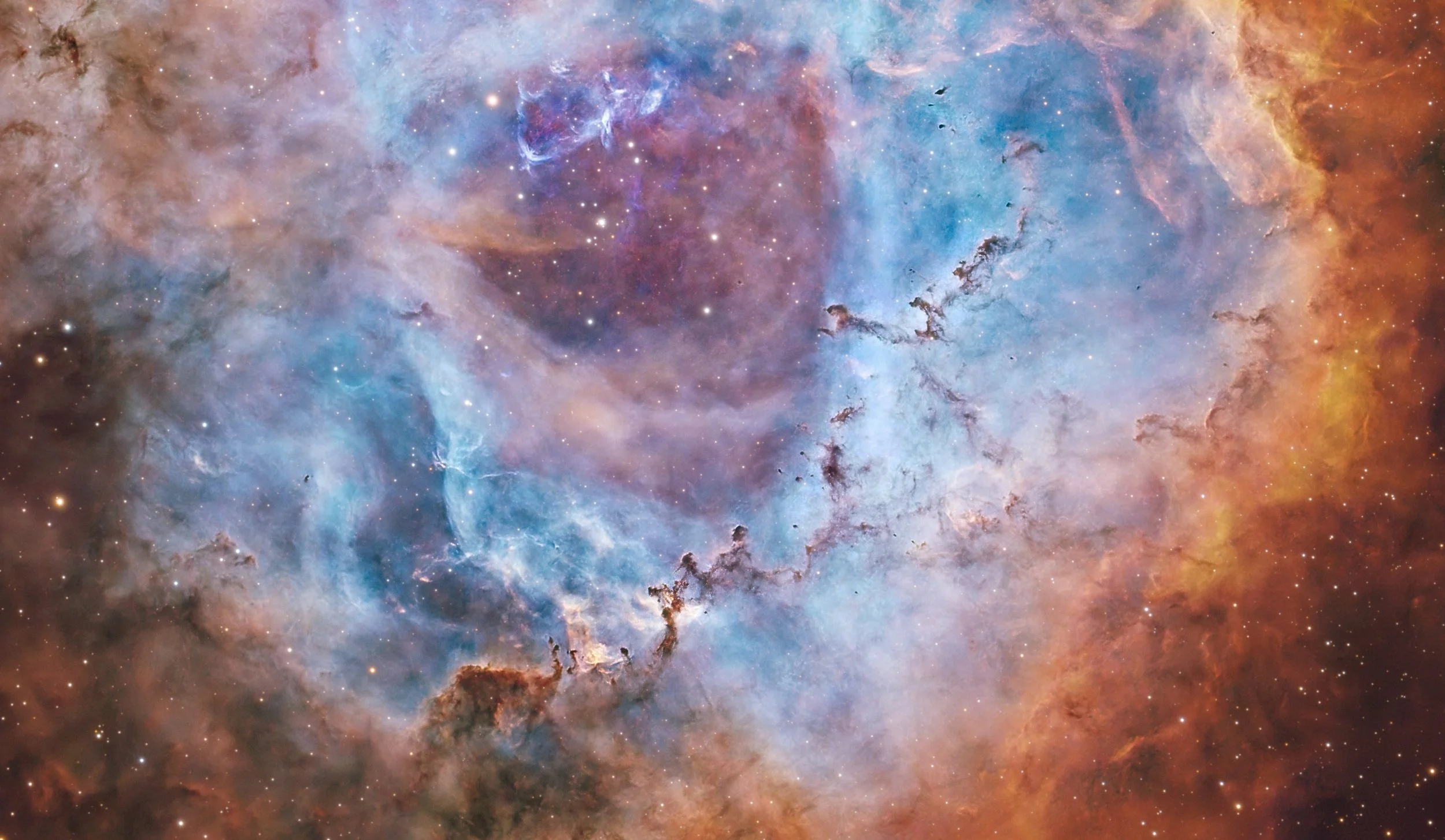
A close-up view of the animals
Acquisition details:
Optolong L-eXtreme lights:
8hr 15min
99x 300sec
Optolong L-Synergy lights:
6hr 15 min
75x 300sec
Calibration frames:
20 Darks
20 Flats
20 Dark flats
Bortle: 5
Gear used:
🔭 Askar 103APO
⚙️ Sky-Watcher EQ6-R Pro
📸 ZWO ASI294MC Pro
🌌 Optolong L-eXtreme & L-Synergy 2”