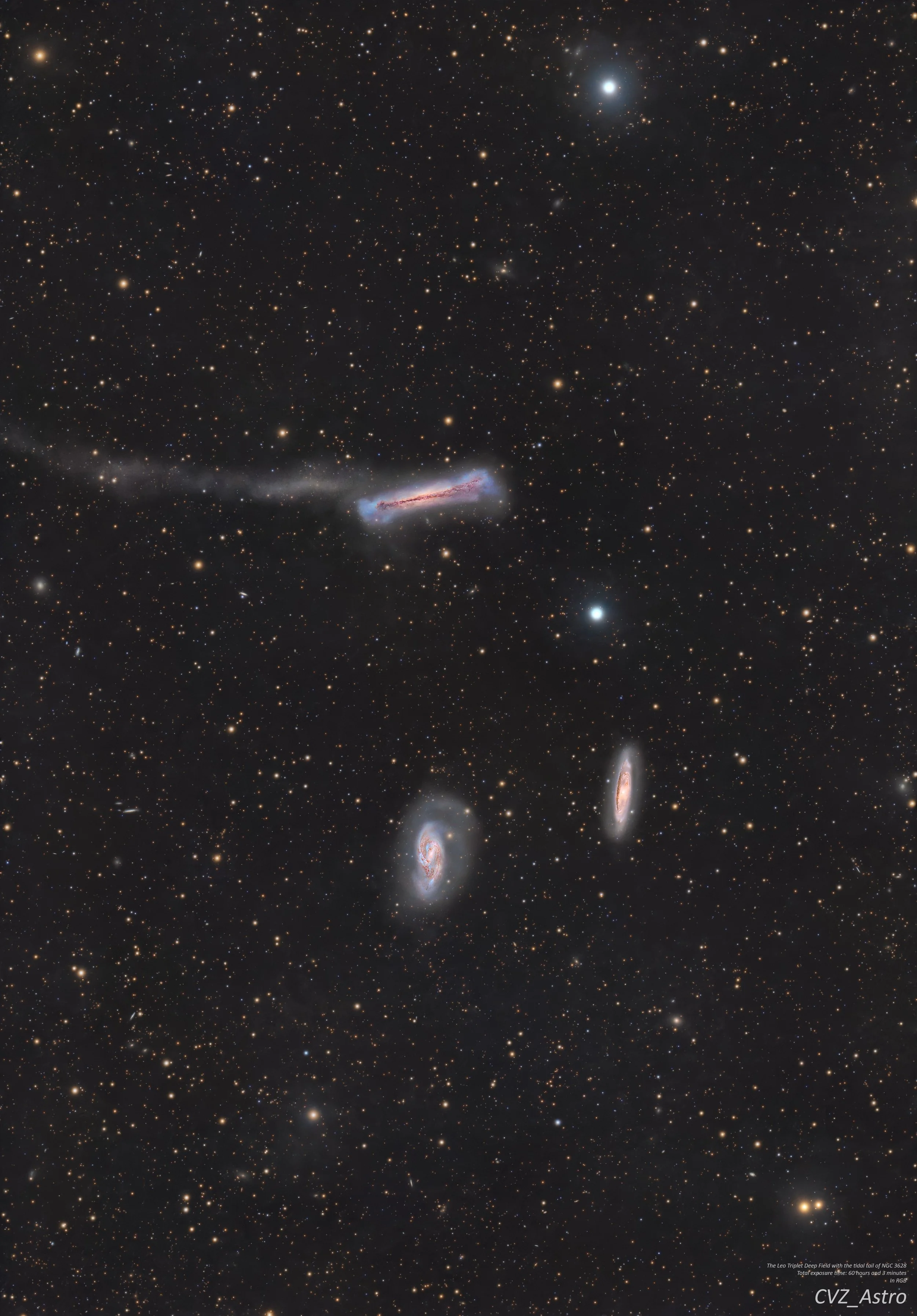
The Leo Triplet Deep Field with the tidal tail of NGC 3628
At the end of 2024, I bought my Askar 103APO telescope. For the first time I finally had enough focal length to seriously focus on galaxies during galaxy season. Shortly before the start of the 2025 galaxy season, I also decided to begin a new long term project, capturing the entire Messier Catalog! Since the catalog contains many galaxies, I spent nearly every clear night imaging a different object. At the beginning of April, it was time for the Leo Triplet. I collected about one and a half hours of data using my Optolong L-Pro filter, a filter I frequently used at the time to combat the light pollution from the streetlights in my neighborhood, which have since been replaced. While processing that first set of data, I already had the idea of returning to this object in 2026. By then I expected to have completed a large portion of the Messier Catalog and would be able to dedicate more time on one object. What I did not know at the time was that this would eventually become the largest and longest astrophotography project I had ever undertaken. Also it happened that the Leo Triplet was the Deep-Sky tip of April 2026 on my favorite podcast, the Sterrenstof podcast. It really was the perfect time to start.
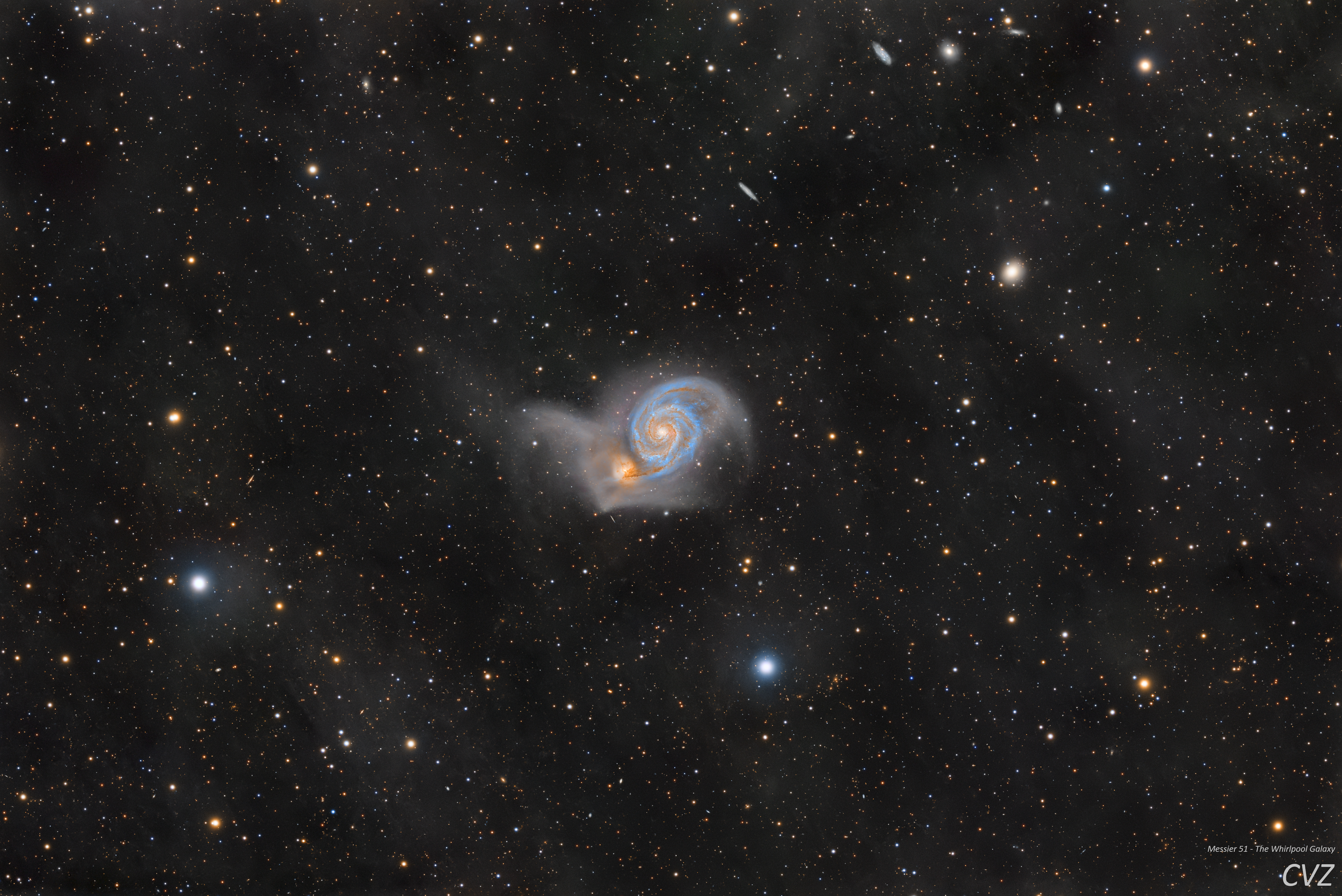
Throughout 2025 I came across images from other astrophotographers showing NGC 3628, one of the three galaxies that make up the Leo Triplet, with an incredibly long tidal tail stretching far into space. To be completely honest, I did not even know this structure existed until then! I understood that revealing such a tidal tail would require an massive amount of exposure time. Earlier in 2025 I had photographed the tidal tails surrounding Messier 51, and those only became truly apparent and detailed after roughly 50 hours of integration time. Of course faint structures like those can be made visible earlier by stretching the data more, but that often comes at the expense of image quality. With that in mind, I began this project on April 6 2026. My goal was ambitious: collect at least 60 hours of exposure time in order to capture not only the tidal tail of NGC 3628, but also the extended halos of dust and stars surrounding Messier 66 and as many distant background galaxies as possible. I was incredibly fortunate with the weather. In the end I gathered data on the Leo Triplet over the course of 18 clear nights. During that period, I even managed to travel twice to photograph several Messier objects that are not visible from my balcony.
In total I collected approximately 80 to 85 hours of data. However I am quite critical when evaluating my subframes. After every session a significant portion of the data was often rejected due to thin clouds, excessive moonlight, passing planes, or simply less sharp exposures. As a result exactly 60 hours and 3 minutes of usable data remained. Precisely the goal I had set for myself!
After 14.5 hours of stacking my computer finally finished processing the data, and I was able to examine the master stack for the first time. There were several unusual gradients present, but fortunately they were easily removed using the Gradient Correction tools in Pixinsight. What remained was exactly what I had hoped to see: the three galaxies of the Leo Triplet, Messier 66 surrounded by an enormous halo of dust and stars, the long tidal tail of NGC 3628, and countless tiny orange smudges scattered throughout the field. The distant background galaxies.
One more fun detail about this entire 2 month journey. While browsing the Dutch Astroforum, I came across a post by Astrobug about a PixInsight script capable of automatically identifying galaxies within an image. Once an image has been plate solved and Pixinsight knows exactly where it was taken in the sky, the script can even generate a showcase poster showing all identified galaxies. As many of you probably know, I am a big fan of these kinds of showcase posters! In this image the script successfully identified no fewer than 548 galaxies from various astronomical catalogs.
I will include the poster on the bottom of this page, because it is quite big. I highly recommend taking a look at it. There is an incredible amount of small galaxies to discover. You may also notice that not every visible galaxy has been marked by the script. Perhaps some of those objects simply do not have catalog designations, although I cannot say for certain. What I do know is that I will probably spend the next few days looking at this image over and over again. Simply looking at how much detail, structure, and colour can be revealed when you dedicate 60 hours of exposure time to a single object from a balcony in North Holland.
As always I will add a longer description in the near future. One where I go a little more indepth about the objects seen in the image. To be continued!
Acquisition details:
Optolong UV/IR Cut lights:
60hr 3min
1201x 180sec
Calibration frames for each night:
20 Darks
20 Flats
20 Dark flats
Bortle: 5
Gear used:
🔭 Askar 103APO
⚙️ Sky-Watcher EQ6-R Pro
📸 ZWO ASI2600MC AIR
🌌 Optolong UV/IR Cut 2“

The 548 Galaxies of my Leo Triplet Deep Field
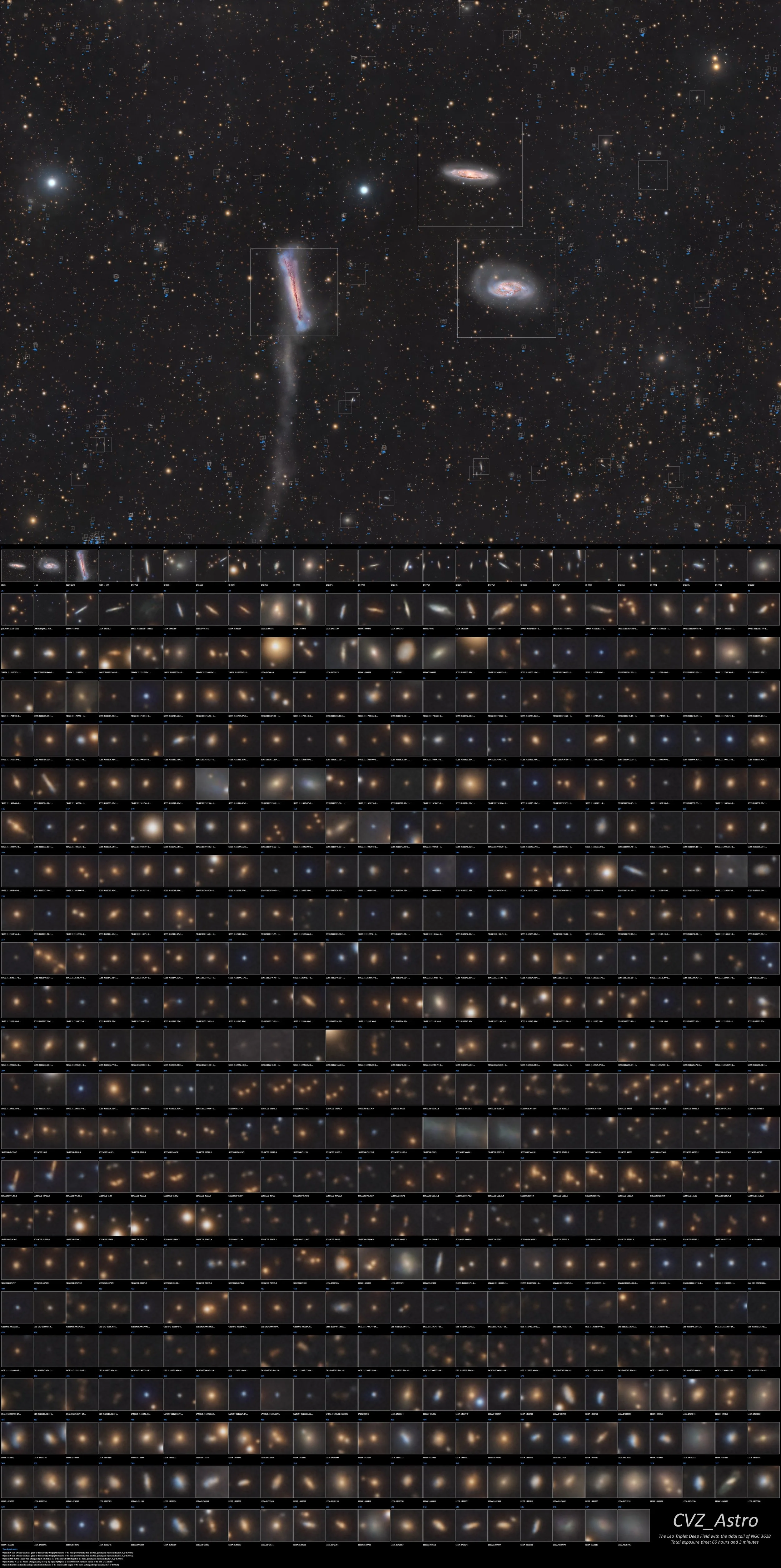
Poster of all the 548 Galaxies found in my Leo Triplet Deep Field image of 2026, my longest project till date
My previous capture of the Leo Triplet

The Leo Triplet, photographed in April of 2025