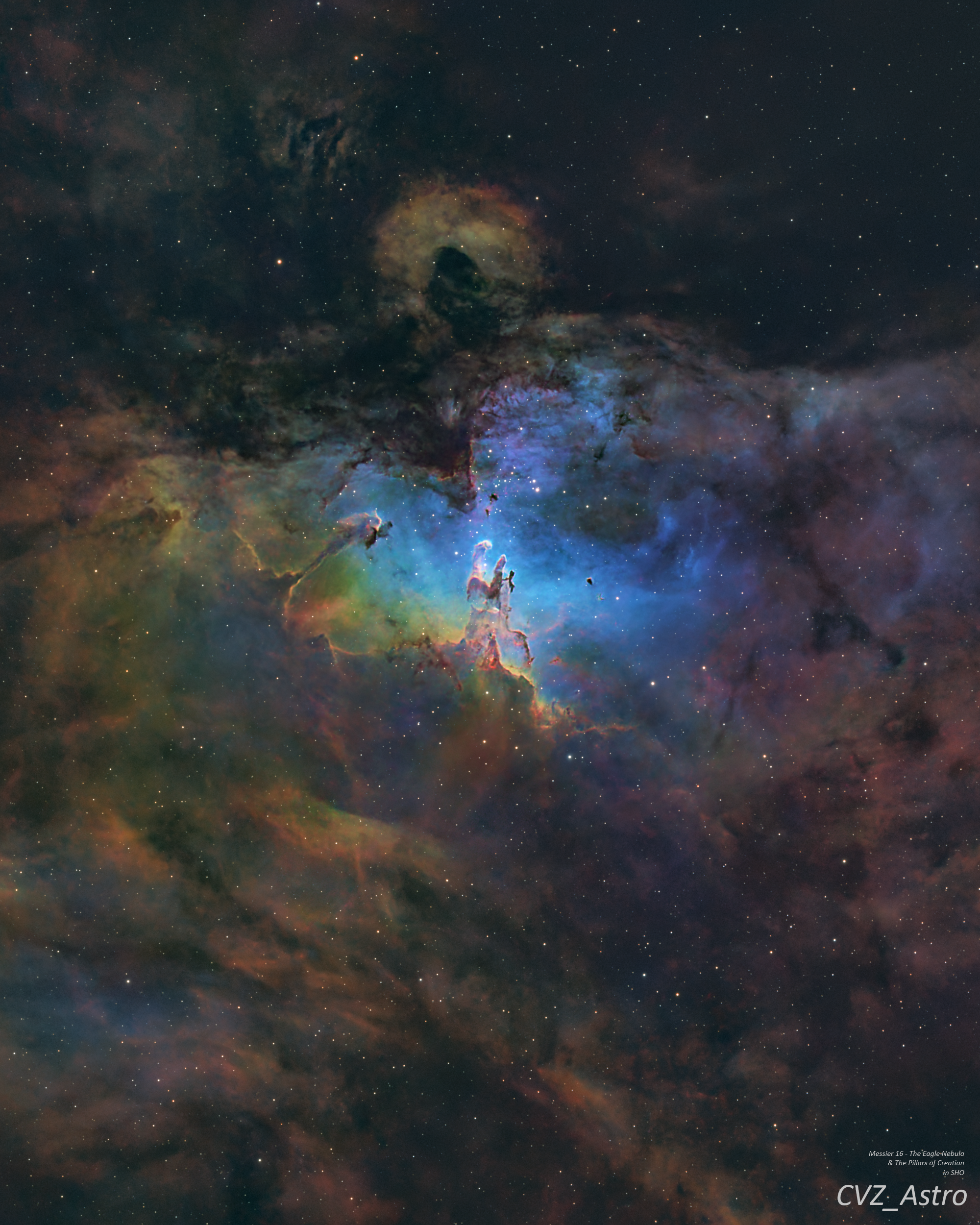
Messier 16 - The Eagle Nebula
Approximately 7,000 light-years from Earth lies a nebula that, second only to Messier 42, might be the most famous nebula of all! Messier 16, the Eagle Nebula. It owes much of its fame to a Hubble Space Telescope image of a small region within it, the legendary Pillars of Creation, a photograph that has become one of the most recognisable astronomical images ever taken, reproduced everywhere from textbooks to postage stamps since Hubble first captured it in 1995.
The Eagle Nebula itself is a vast region of ionised hydrogen gas and dust, spanning around 70 by 55 light-years, and it takes its name from the resemblance some observers see in its overall shape to a bird of prey with outstretched wings. And especially in the new Hubble iamge of this region, it really resambles an eagle. Embedded within this glowing cloud lies the young open cluster NGC 6611, positioned just above the famous pillars. The hot, massive stars of this cluster, some no more than a few million years old, are what illuminate the surrounding gas in the first place, ionising the hydrogen and giving the nebula its characteristic red glow. It is the same fundamental process I have written about before with other stellar nurseries, young, stars carving out and lighting up the very clouds of gas from which they themselves were born.
The Pillars of Creation, the small region within the Eagle Nebula that made it so iconic, are towering columns of cold molecular hydrogen and dust, the tallest of which stretches roughly four light-years from base to tip, taller than the distance between our sun and its nearest stellar neighbour. These pillars are dense enough to resist the radiation and stellar winds coming from NGC 6611, while the surrounding, less dense gas is stripped away, leaving these finger like structures. Deep within the pillars, dense balls of gas known as evaporating gaseous globules are collapsing under their own gravity to form new stars, quite literally being born inside these columns even as the columns themselves are slowly being eroded from the outside in. In Dutch the Pillars of Creation are known as "De Zuilen der Schepping", and I have always had a small soft spot for this translation, given that it happens to share its name with mine!
During the nights of 12 August 2026 and 24 August 2026, I headed out with my Askar telescope to finally capture this object properly. I had photographed it once before in the HOO palette, but now that I have the Optolong L-eXtreme and L-Synergy filters, I could not bring myself to finish my Messier Catalogue project without an SHO version of it as well, recreating that famous Hubble colour palette myself! Since this nebula is not visible from my balcony, this meant two nights of sleeping in the car next to a field under a dark sky.
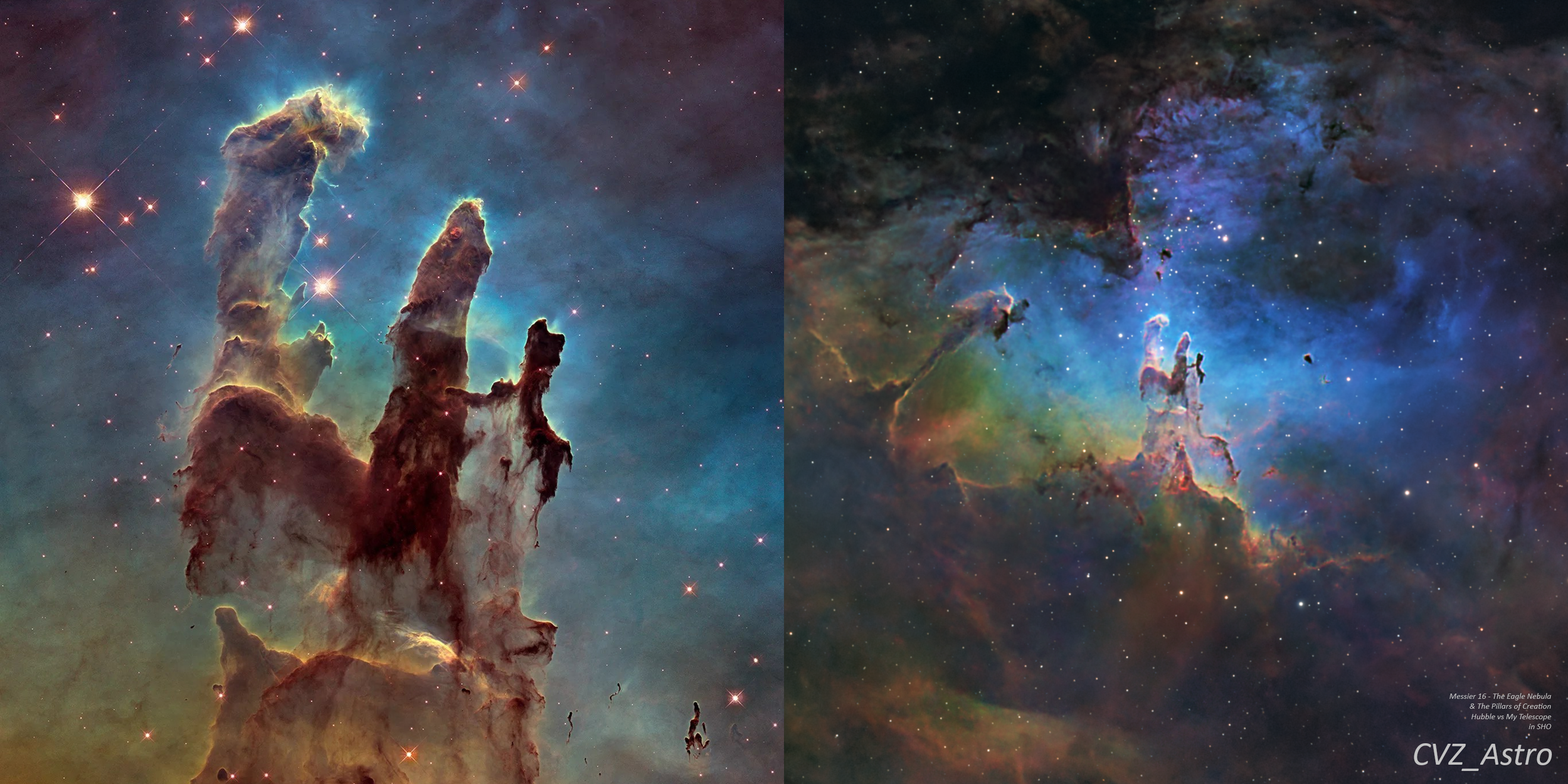
Just for fun: Hubble vs My Telescope
It did not go entirely without a hitch, though. During the first night, someone suddenly came speeding up in a car in the middle of the night, even though I have never run into anyone at my observing spot before. I was genuinely scared out of my wits, but it turned out to be a very friendly older lady who wanted to watch the Perseids that night. On the second night it got rather windy, forcing me to move the telescope to a different spot in the middle of the imaging session, in the end half of my subs ended up with trailed stars as a result, a frustrating but familiar setback when imaging from an exposed field rather than a fixed setup.
Despite the setbacks. I managed to gather a shot I am genuinely happy with, caught some beautiful Perseid meteors streaking across the sky along the way, and finally have my own SHO version of one of the most photographed regions in the night sky sitting alongside my earlier HOO version. Since Messier 16 is not going anywhere, and there is clearly a great deal more detail waiting to be teased out of the Pillars of Creation with more integration time, I will definitely be back for a bigger, dedicated project on it someday.
Acquisition details:
Optolong L-eXtreme lights:
1hr 35min
19x 300sec
Optolong L-Synergy lights:
2hr 30min
30× 300sec
Calibration frames:
20 Darks
20 Flats
20 Biases
Bortle: 5
Gear used:
🔭 Askar 103APO
⚙️ Sky-Watcher EQ6-R Pro
📸 ZWO ASI2600MC AIR
🌌 Optolong L-eXtreme & L-Synergy