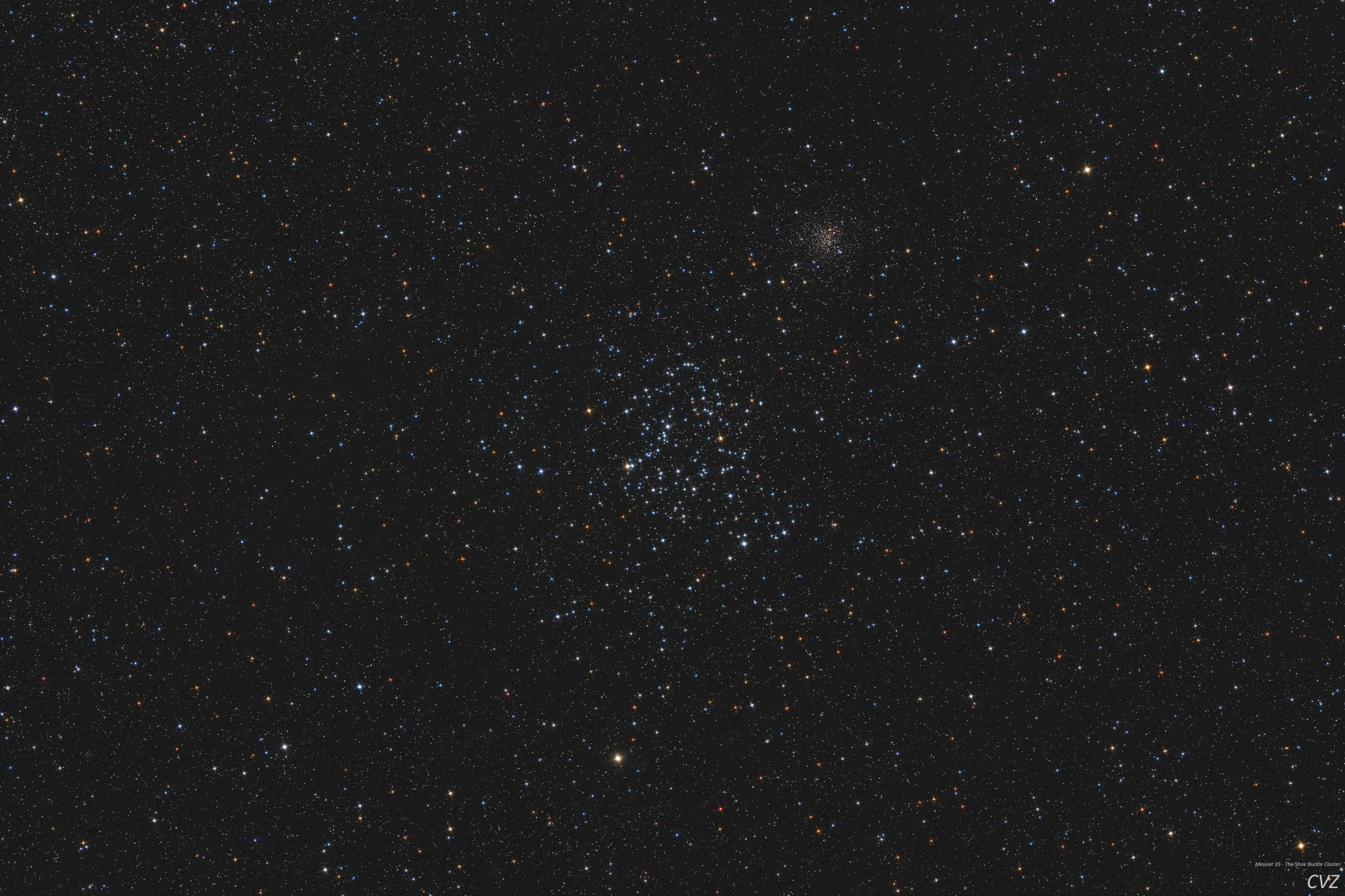
Messier 35 - The Shoe Buckle Cluster
Messier 35 is an open cluster in the constellation Gemini. It is located at a distance of about 2,800 light-years from Earth. The cluster contains around 300 stars and has an apparent magnitude of 5.1, which means it can be seen with the naked eye from a dark-sky location. When observed without a telescope or binoculars, it appears as a faint smudge in the sky.
However, when viewed through a telescope, there is something else visible in the same field of view, the cosmic companion of Messier 35, NGC 2158. This is a yellowish, compact star cluster located much farther away, at a distance of about 16,000 light-years from Earth. For astrophotographers like myself, pairs like these are fascinating to observe. Both are star clusters, yet they are vastly different from each other.
Hertzsprung-Russel diagram of Messier 35
Using the Cosmic Photons Hertzsprung–Russell diagram script, which I recently discovered while watching some YouTube videos by Adam Block, I have been creating a number of these HR-diagrams. Since this image features two star clusters, it finally gave me the opportunity to make two separate HR-diagrams for a blog post.
Of course the first one we start with is Messier 35. This open cluster is relatively young, with an estimated age of about 100 million years, and this youth is clearly visible in the HR-diagram. The main sequence is populated by many hot, blue stars, indicating that the more massive stars have not yet evolvedinto giant stars. On the right side of the diagram there are few giant stars visible. However, it is not entirely clear for me whether these stars belong to the cluster or if they are foreground stars in the same line of sight. When generating the diagram, I did apply both circular selection and distance filters to isolate the cluster, so it is possible that these giants are members of Messier 35.
The second HR-diagram shows NGC 2158, the older companion of Messier 35 located in the background of Messier 35. This HR-diagram looks a bit different compared to the one of Messier 35. There are fewer main sequence stars and a much larger number of evolved giant stars, this is quite common in older clusters. NGC 2158 is estimated to be around 2 billion years old, so it may seem weird to find blue stars in main sequence of the diagram. Many of these are believed to be blue stragglers, often formed in binary systems where one giant star transfers mass to its companion. This process makes the receiving star hotter and more luminous, causing it to appear younger than it actually is.
Being able to create these HR-diagrams is a lot of fun. They add an extra layer of scientific context to my images and help tell a story about the evolution and composition of stars within these clusters.
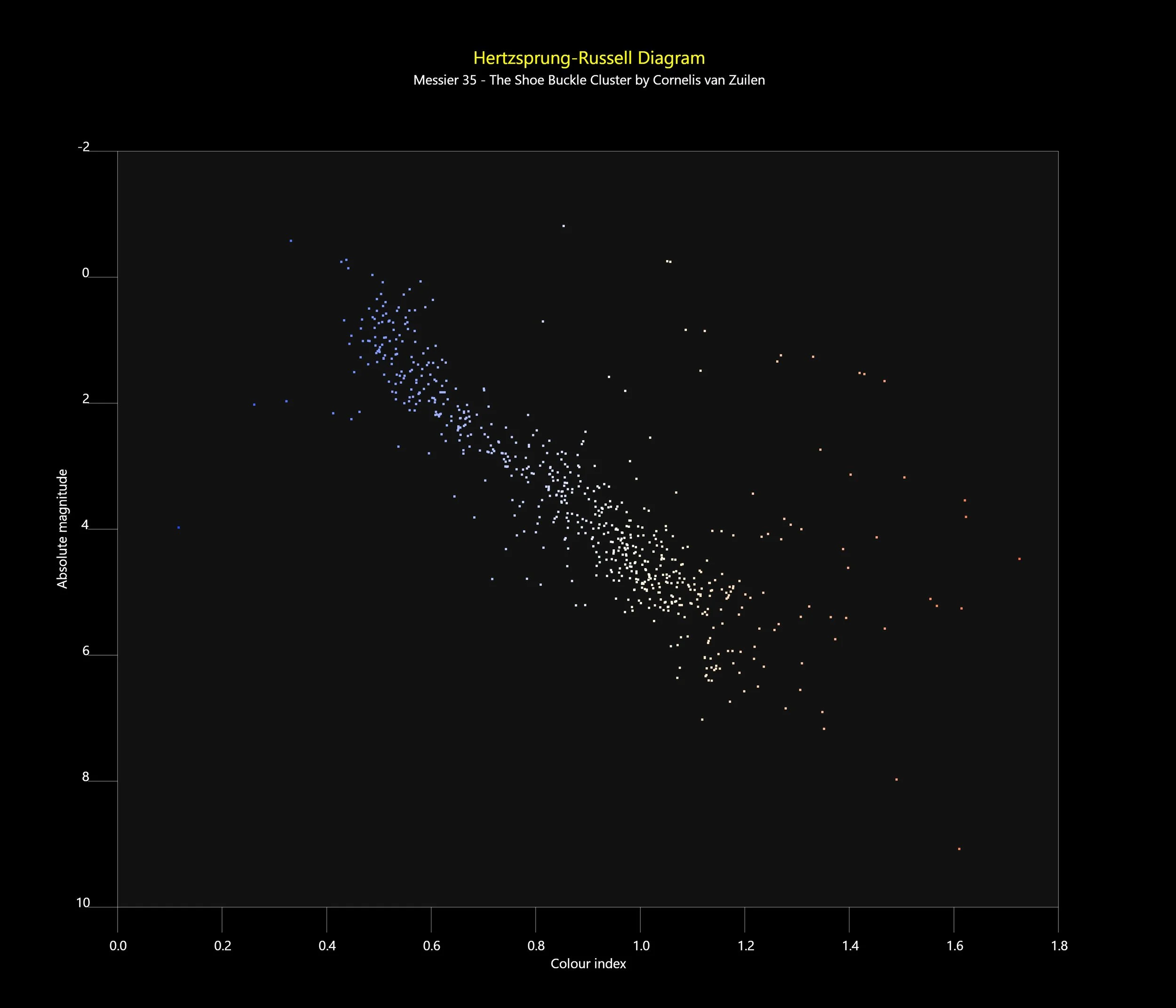
The HR-diagram of Messier 35, showing the lifecycle of stars
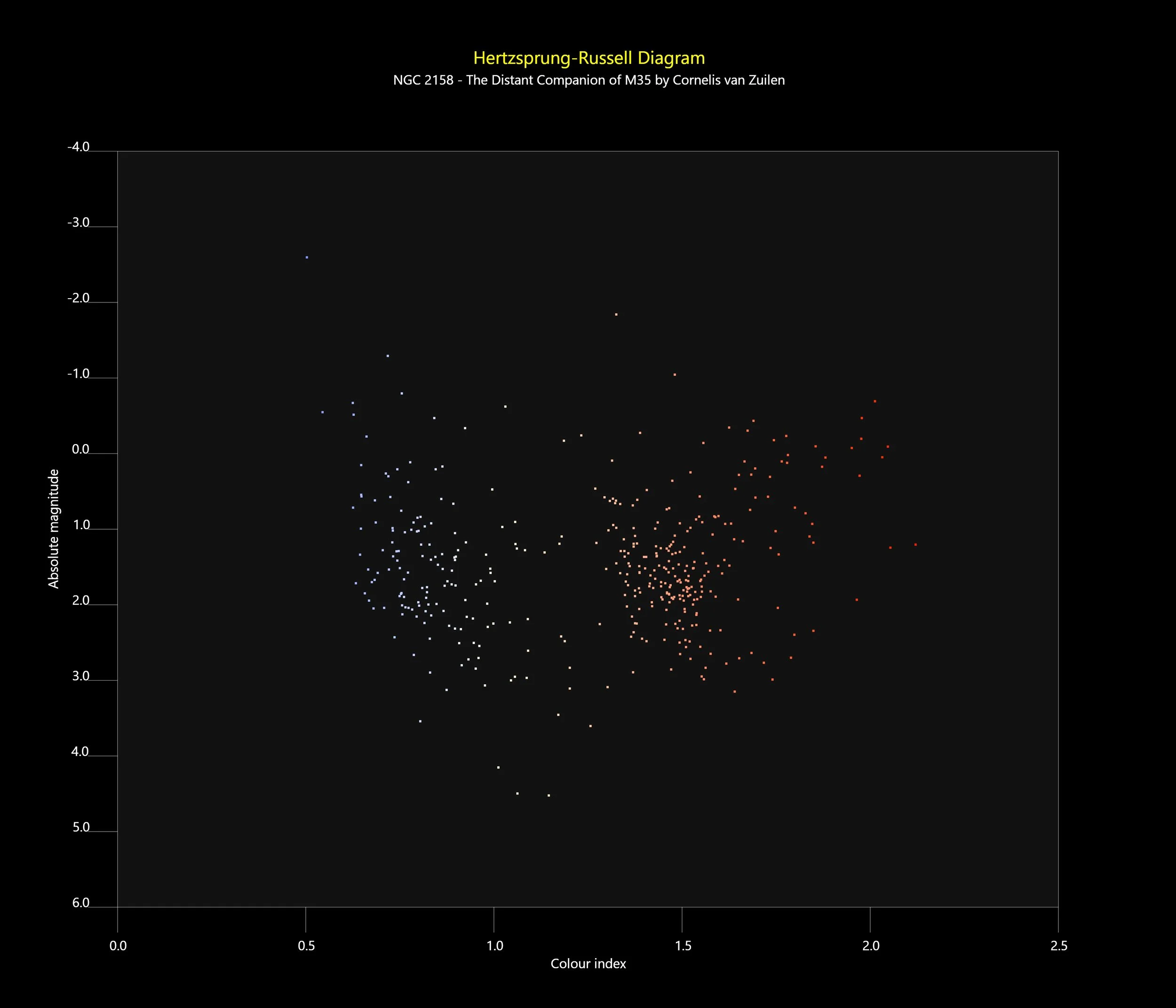
The HR-diagram NGC 2158, showing the lifecycle of stars
Acquisition details:
Optolong L-Pro lights:
0hr 30min
10x 180sec
Calibration frames:
20 Darks
20 Flats
20 Dark flats
Bortle: 5
Gear used:
🔭 Askar 103APO
⚙️ Sky-Watcher EQ6-R Pro
📸 ZWO ASI2600MC AIR
🌌 Optolong L-Pro