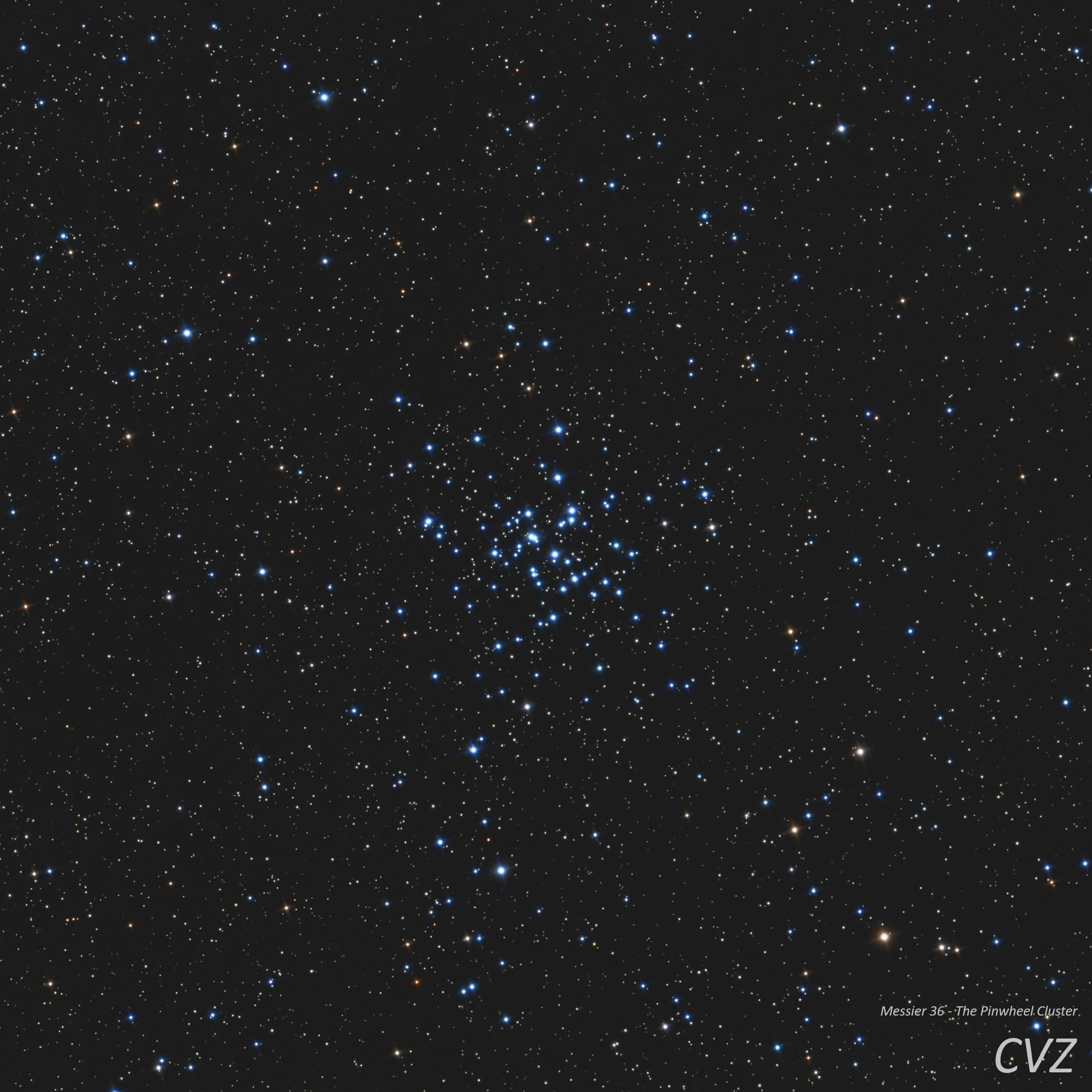
Messier 36 - The Pinwheel Cluster
Messier 36, also known as the Pinwheel Cluster is an open cluster in the constellation Auriga. I have read in a book by Gary Imm that it likely got its nickname from the X-shaped pattern formed by its brightest stars, but to be honest, I don’t really see it! It might be more clear when looking trough a telescope with your own eyes. It was discovered by the astronomer Giovanni Battista Hodierna sometime before 1654, who described the cluster as a faint nebulous patch in the sky. Later, it was rediscovered by Guillaume Le Gentil in 1749, before he became a professional astronomer. Of course, Charles Messier also came across it while searching for comets, and he observed and cataloged it in 1764.
The cluster is located at a distance of about 4,100–4,340 light-years from Earth. It contains around 60 stars, which makes it relatively small and earns it a place as the third smallest Messier object in the entire catalog. Messier 36 has an apparent magnitude of 6.1, which makes it so small that is listed as the third smallest Messier object in the entire catalog. However, it is much easier to observe with binoculars or a telescope.
Messier 36 is a relatively young cluster, populated mostly by blue B-type stars. In this image a few orange stars appear to be part of the cluster, but this is merely a line of sight effect. Clusters like these are often overlooked while searching for potential targets to capture, reading about all the special things each cluster contains can be a fun experience.
Acquisition details:
Optolong L-Pro lights:
0hr 30min
10x 180sec
Calibration frames:
20 Darks
20 Flats
20 Dark flats
Bortle: 5
Gear used:
🔭 Askar 103APO
⚙️ Sky-Watcher EQ6-R Pro
📸 ZWO ASI2600MC AIR
🌌 Optolong L-Pro