Messier 38 - The Starfish Cluster
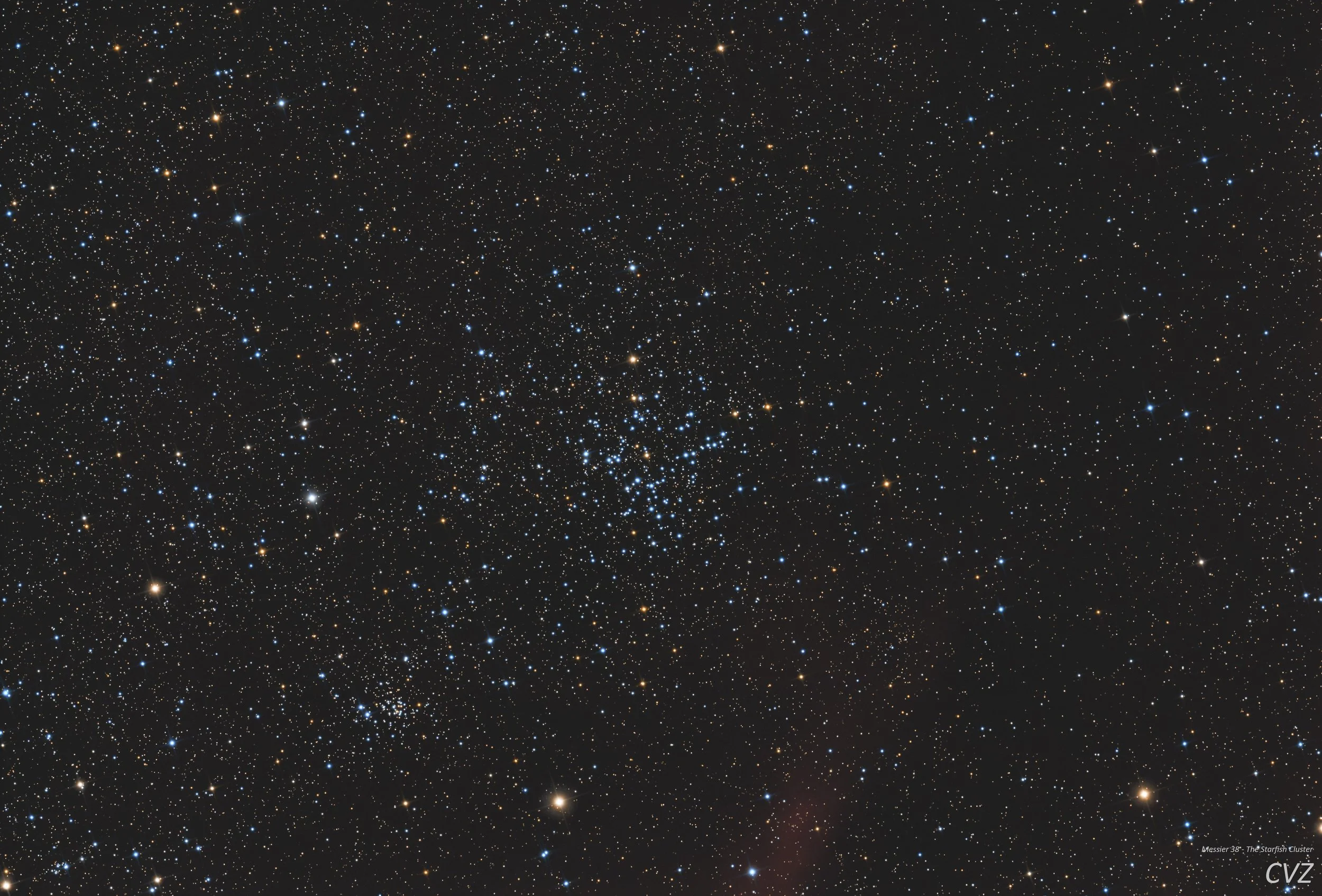
Messier 38, also known as the Starfish Cluster, is an open cluster in the constellation Auriga. It was discovered by the astronomer Giovanni Battista Hodierna sometime before 1654 and was later rediscovered and cataloged by Charles Messier in September 1764. As you may have read in my earlier blog posts, the Starfish Cluster is one of the three bright open clusters in Auriga. The cluster is located at a distance of about 4,200 light-years from Earth, making it slightly closer than Messier 37. Like Messier 37, this cluster contains many blue B-type main sequence stars, along with several orange giants. Messier 38 has an apparent magnitude of 6.4, which makes it visible to the naked eye under very dark skies, though it is way easier to find with binoculars or a telescope.
The Starfish Cluster earned its nickname from the X-shaped pattern it resembles when viewed through a telescope. In an image like this, containing many bright stars, that shape is less obvious, to me it looks more like the letter K or an E. Near the beautiful X-shaped cluster lies another open cluster. This one is denser than Messier 38 and located at least 5,200 light-years as far away. It carries the designation NGC 1907 and it had an apparent magnitude brightness of 8.2, it is not possible for us humans to see that with the naked eye.
But there was something else as well! While editing the image, I noticed a faint streak of HII emission near the edge of the frame. It took me a while to determine which nebula it belonged to, but since the cluster resides in Auriga, it is safe to say that it is part of the Auriga Nebula Complex. This region contains several nebulae that I have already photographed, such as IC 405, the Flaming Star Nebula, and IC 410, the Tadpoles Nebula. After some research, I discovered that this particular streak of HII emission is known as LBN 794.
In the distant future, perhaps in a few hundred million years, open clusters like Messier 36, 37, and 38 will have dispersed, their stars spreading into the galactic disk of the Milky Way, just like our sun did a long time ago. Knowing that we happen to live at just the right moment to see these clusters in their present form makes me truly appreciate our place in time.
Acquisition details:
Optolong L-Pro lights:
0hr 30min
10x 180sec
Calibration frames:
20 Darks
20 Flats
20 Dark flats
Bortle: 5
Gear used:
🔭 Askar 103APO
⚙️ Sky-Watcher EQ6-R Pro
📸 ZWO ASI2600MC AIR
🌌 Optolong L-Pro