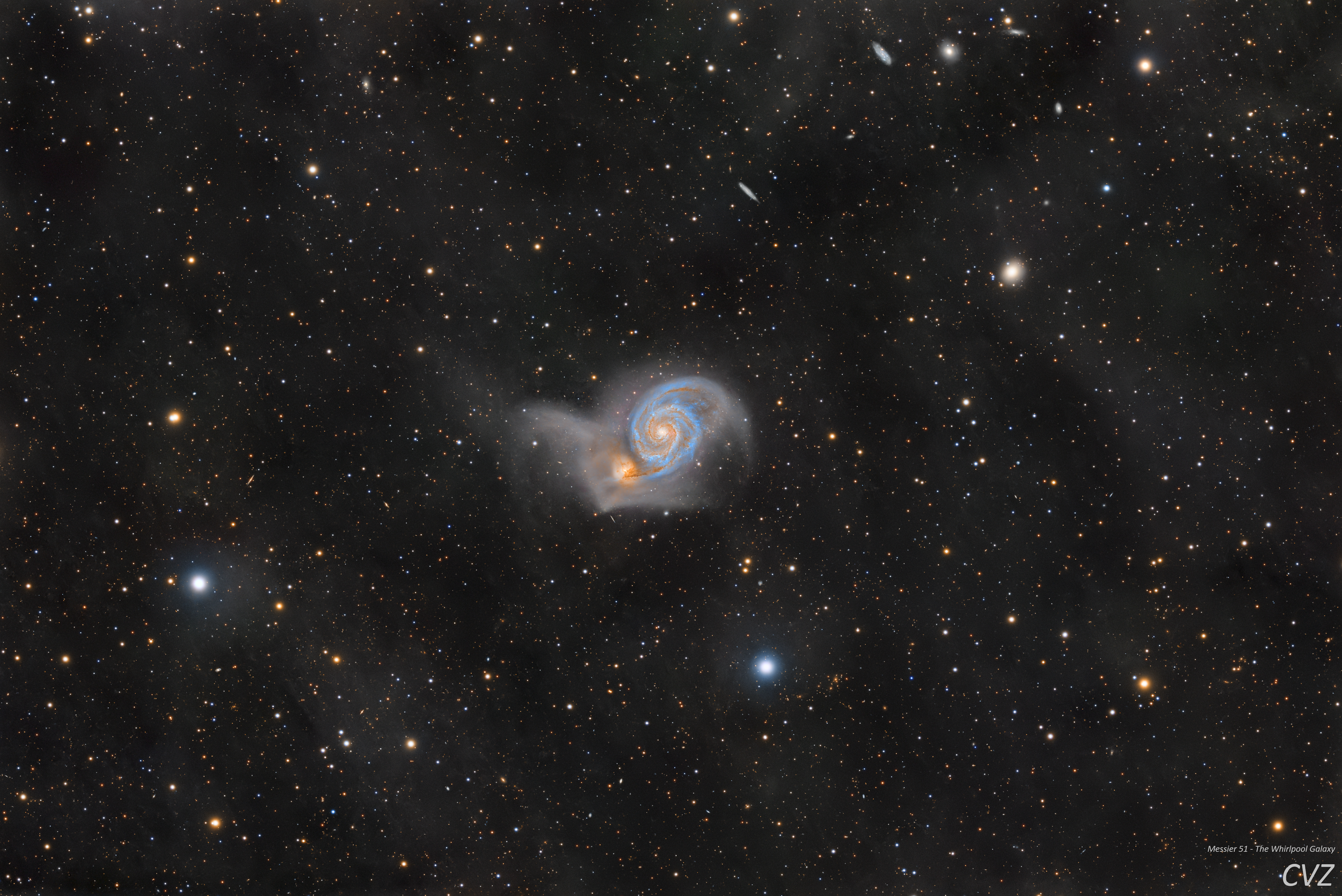
Messier 51 - The Whirlpool Galaxy and the Integrated Flux Nebula
A historical perspective on Messier 51, the Whirlpool Galaxy
Messier 51, also known as the Whirlpool Galaxy, is one of the most well kown spiral galaxies our the night sky. It is located in the constellation Canes Venatici, but I used to find it by following the tail of Ursa Major. It has fascinated astronomers for centuries. Unlike the Andromeda Galaxy, which is visible to the naked eye, Messier 51 requires a telescope to reveal its beauty, but what it reveals is extraordinary. The galaxy was first discovered in 1773 by Charles Messier’s colleague Pierre Méchain, who reported the object to Messier not so long after. Messier added it to his famous catalogue as entry number 51. With the modest telescopes of the 18th century M51 appeared as a faint, round nebula without structure.
It was not until 1845 that the true nature of this object began to be uncovered. Using the 72-inch Leviathan of Parsonstown, the largest telescope in the world at the time, William Parsons sketched the spiral structure of M51. This marked one of the first times spiral structure was observed in a “nebula”, decades before astronomers understood that such objects were galaxies far beyond the Milky Way. Observations like these would later contribute to the great debate about the nature of spiral nebulae, A debate ultimately settled by Edwin Hubble in the 1920s when he found standard candles in the Andromeda Galaxy and proved that these spiral nebulae were island universes outside our Milky Way. You know... galaxies.
Object data about Messier 51 and the IFN
Today we know that Messier 51, also catalogued with the designation NGC 5194 (M51a), is a grand-design spiral galaxy located approximately 23 million light-years away from our planet. It is interacting gravitationally with its smaller companion galaxy, NGC 5195 (M51b). This interaction is responsible for the pronounced and beautifully defined spiral arms that make M51 such a popular imaging target.
With an apparent magnitude of about 8.4, Messier 51 is good target even for small telescopes under dark skies. Visually observer may see its bright core and hints of spiral structure. It might have been the bortle 6 skies I have lived under back in the day, but I personally never seen it with my own eyes while using my old Omegon Advanced 150/750 telescope. But by using a deep-sky camera, M51 was finally obtainable for me. Even using my smaller William Optics Redcat 51 telescope, I was able to capture the dark dust lanes in the whirpool of M51a and even some details in M51b.
The Whirlpool Galaxy spans roughly 60,000 light-years in diameter, it is smaller than both our Milky Way and the Andromeda Galaxy, yet its structure is really well defined. The tidal forces between M51a and M51b have triggered waves of star formation, illuminating its spiral arms with clusters of young, hot blue stars and red emission nebulae. In the future I would like to go back to the object and use my new Optolong L-eXtreme filter to capture these red emission nebulae.
With extensive integration time, such as my final image with 53 hours of data, even fainter structures begin to appear that are not part of M51, but are surrounding our own galaxy, known as the Integrated Flux Nebula (IFN). The IFN is extremely faint interstellar dust illuminated by the combined starlight of the Milky Way. The Integrated Flux Nebula is something I have captured before. The first time was in 2024 when I was phographing Messier 81, the Bode’s Galaxy and its friend Messier 82, the Cigar Galaxy. After 8 hours of integration, a faint glow of the Integrated Flux Nebula became visible. After 18 hours, the IFN had developed so much detail that it almost became the main feature of the image itself. It remains one of my favorite images, and now that I have gained considerably more experience in processing astrophotography data, it may be time to revisit and reprocess it.
Like I just explained, this interstellar dust is not part of M51 itself, but that does not mean the Whirlpool Galaxy does not have something spectacular of its own. I call them the “teeth” of the Whirlpool Galaxy. Enormous faint tidal streams extending far beyond both M51a and M51b, formed by their ongoing gravitational interaction. These elongated, teeth-like streams of stars are remnants of M51a and M51b their interactions over million of years. On the left side of M51b in my image, the massive tidal stream extends even farther, although it remains extremely faint even after 53 hours of integration time. Before I started this project, I did not even know that the IFN and this extended tidal stream were present in thi field of view, so it was a very nice surprise to find them in my final stack.
Something else that I really like about this final image are all the tiny orange dots you see. Some of them are stars in our Milky Way, but the small less star-shapes spots are actually background galaxies that are really far away. Some of them even a few billion light-years! Compared to M51, that lies at a distance of 23 million light-years from us, being able to see those spots feels insane.
Comparing 2024 with 2025
I also photographed Messier 51 in both 2023 and 2024 using my William Optics Redcat 51 MK2.5 telescope, with a total integration time of approximately 10 hours. At the time I was already very happy with those results, but I really wanted to know what else would be visible if made this into a bigger project with a different telescope.
At the end of 2024 I bought the Askar 103APO combined with a x0,80 flattener reducer. This is a significantly better telescope for small galaxies, because of the longer focal length.
My original goal was simply to create a deepfield-like image of M51, partly because it has always been one of my favorite galaxies. At the same time, I was very curious to discover what structures might be hidden within this region of the sky. I never expected to reveal features such as the faint Integrated Flux Nebula, the enormous tidal streams surrounding the galaxy pair, and countless distant background galaxies scattered throughout the field.
Below you can see an animation comparing my 2024 image with the new 2025 result, clearly showing how much additional detail became visible with the larger telescope and the greatly increased integration time.
Comparing the 2024 and 2025 results
Acquisition details:
Optolong UV/IR Cut lights:
53hr 54min
1078x 180sec
Calibration frames for each night:
20 Darks
20 Flats
20 Biases
Bortle: 5
Gear used:
🔭 Askar 103APO
⚙️ Sky-Watcher EQ6-R Pro
📸 ZWO ASI294MC Pro
🌌 Optolong L-Pro